

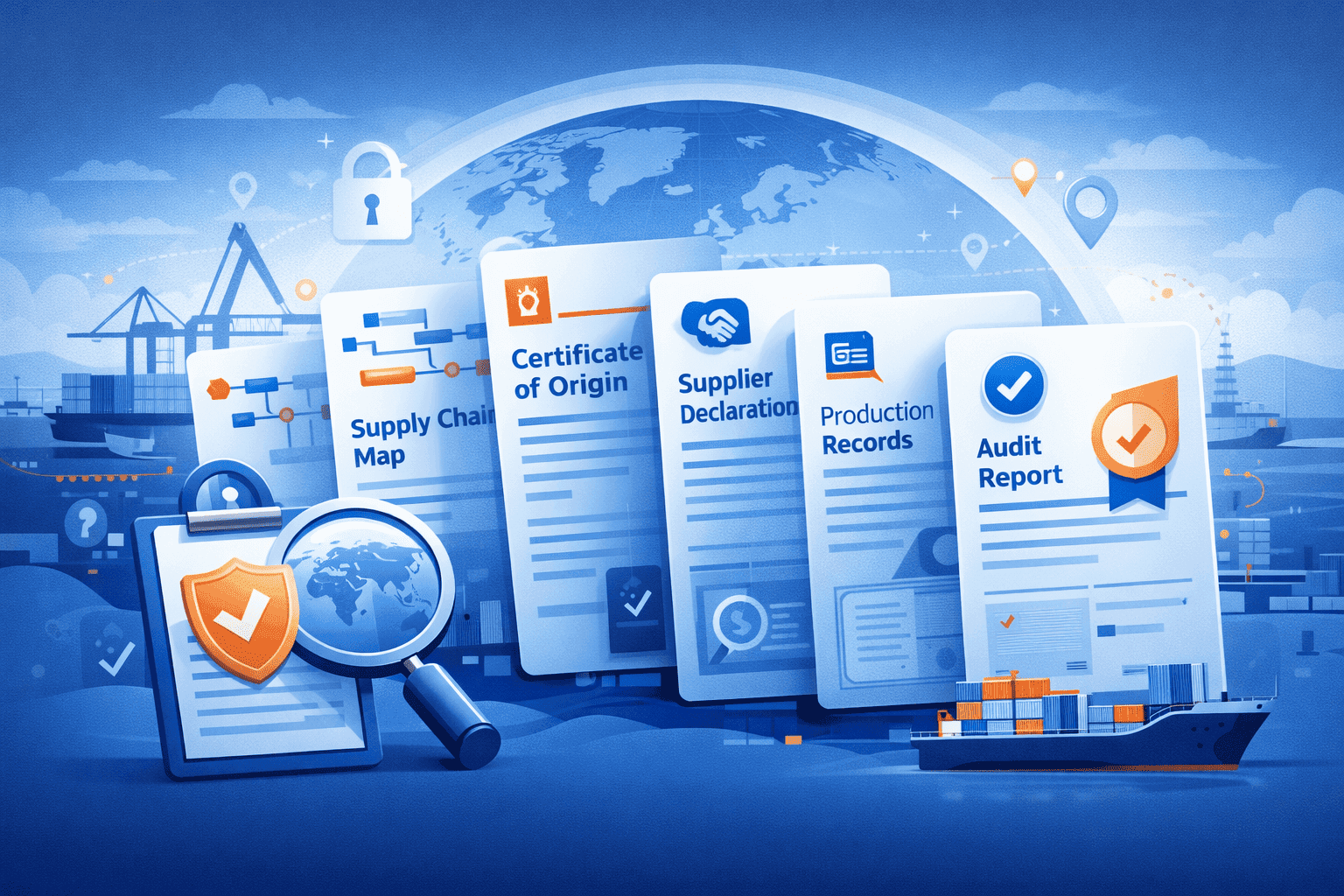
When CBP detains goods under UFLPA, the burden falls on you to prove your supply chain is clean. Importers who succeed have one thing in common: they’ve collected the right documentation before they need it.
Here are the five essential documents every importer should maintain for UFLPA compliance.
1. Supply Chain Map
What It Is
A visual or written representation showing every step in your product’s journey, from raw materials to finished goods arriving at US ports.
Why CBP Wants It
The supply chain map demonstrates you understand where your goods come from. It’s the foundation for all other documentation—CBP uses it to identify potential Xinjiang connections.
What to Include
- Raw material sources (country and region)
- Processing/manufacturing facilities (with addresses)
- Intermediaries (trading companies, consolidators)
- Final manufacturer (name, address, export country)
- Your company as the importer
How to Create It
Raw Material → Processor → Manufacturer → Exporter → [Your Company]
(Country A)    (Country B)   (Country C)    (Country C)   (USA)
Request information from your primary supplier about their supply chain. Ask specifically:
- Where do you source raw materials?
- Who processes or refines these materials?
- Are there any intermediate manufacturers?
- Does any part of this process occur in Xinjiang?
Pro Tip
Don’t accept “China” as a location. You need specific provinces and cities. Xinjiang is the concern, so knowing your goods come from Guangdong or Zhejiang provides valuable differentiation.
2. Certificate of Origin
What It Is
An official document certifying where goods were manufactured or where raw materials originated.
Why CBP Wants It
Certificates of Origin provide third-party verification of manufacturing location. They’re especially important for proving goods were NOT made in Xinjiang.
Types of Certificates
- Manufacturer’s Certificate of Origin: Issued by the producer
- Chamber of Commerce Certificate: Issued by local business chambers
- Government-Issued Certificate: Issued by exporting country’s authorities
What to Look For
The certificate should include:
- Specific manufacturing location (city/province, not just country)
- Product description matching your import
- Date of manufacture
- Manufacturer’s name and address
- Authorized signature and stamp
Common Issues
- Certificates showing only “Made in China” without specific location
- Certificates from trading companies instead of actual manufacturers
- Generic certificates not tied to specific shipments
3. Supplier Declarations
What It Is
Written statements from your suppliers attesting to the origin of goods and absence of forced labor.
Why CBP Wants It
Declarations show your supplier is aware of UFLPA requirements and has confirmed compliance. They also create accountability—suppliers are less likely to provide false information in writing.
What to Include
A strong supplier declaration should state:
“We, [Supplier Name], hereby declare that the goods supplied to [Your Company] under [PO/Contract Number]:
- Are not wholly or in part mined, produced, or manufactured in the Xinjiang Uyghur Autonomous Region of China;
- Are not produced by any entity on the DHS UFLPA Entity List;
- Were not made using forced labor; and
- Our raw material sources include [specific sources] located in [specific locations].
We understand that false declarations may result in legal consequences and termination of our business relationship.”
Getting Suppliers to Sign
Some suppliers resist signing detailed declarations. Approaches that work:
- Explain it’s required for US market access
- Make compliance a condition of continued business
- Offer to pay for third-party audits instead
- Start with new orders rather than existing contracts
4. Production and Traceability Records
What It Is
Documentation linking your specific shipment to the supply chain you’ve mapped, including purchase orders, invoices, shipping documents, and production records.
Why CBP Wants It
Anyone can create a supply chain map or declaration. Production records prove that YOUR goods actually traveled through the clean supply chain you claim.
Key Documents
- Purchase orders between supply chain parties
- Commercial invoices with matching quantities and dates
- Bills of lading showing shipping routes
- Production batch records linking materials to finished goods
- Packing lists with lot/batch numbers
Creating the Paper Trail
Work with suppliers to establish:
- Consistent lot/batch numbering across the supply chain
- Date stamps at each production stage
- Clear documentation linking raw materials to finished goods
What to Verify
- Dates make logical sense (materials purchased before production, production before shipping)
- Quantities align across documents
- Facility addresses match your supply chain map
- Supplier names are consistent
5. Third-Party Audit Reports
What It Is
Independent verification of supplier facilities, labor practices, and supply chain claims by qualified auditors.
Why CBP Wants It
Self-declarations have obvious limitations. Third-party audits provide independent verification that carries significantly more weight with CBP.
Types of Audits
- Social compliance audits (labor practices, working conditions)
- Supply chain audits (verifying origin claims)
- UFLPA-specific audits (focused on Xinjiang connections)
What Makes a Strong Audit
- Recent date (within 12 months)
- Qualified auditor (recognized certification body)
- Unannounced or semi-announced (more credible than announced)
- Covers subcontractors (not just primary supplier)
- Specifically addresses UFLPA requirements
Audit Standards to Look For
- SMETA (Sedex Members Ethical Trade Audit)
- SA8000 (Social Accountability International)
- BSCI (Business Social Compliance Initiative)
- WRAP (Worldwide Responsible Accredited Production)
Cost Considerations
Audits cost money, but compare to the cost of a detention:
- Port storage fees
- Re-export or destruction costs
- Lost sales and customer relationships
- Legal fees for CBP response
Investing in audits for high-risk suppliers is sound risk management.
Putting It All Together
These five documents work together to tell a coherent story:
- Supply chain map shows where your goods come from
- Certificates of origin verify manufacturing locations
- Supplier declarations confirm UFLPA compliance in writing
- Production records prove your specific goods match your claims
- Audit reports provide independent verification
A gap in any area weakens your overall position. A complete package makes CBP’s job easy—and makes release more likely.
The VettedImport Approach
Collecting and organizing these documents manually is time-consuming and error-prone. VettedImport helps importers:
- Screen suppliers against the Entity List before ordering
- Request and store compliance documentation systematically
- Generate CBP-ready compliance packages on demand
- Monitor supply chains for new risks
Ready to organize your UFLPA compliance documentation? Get started free with VettedImport.