

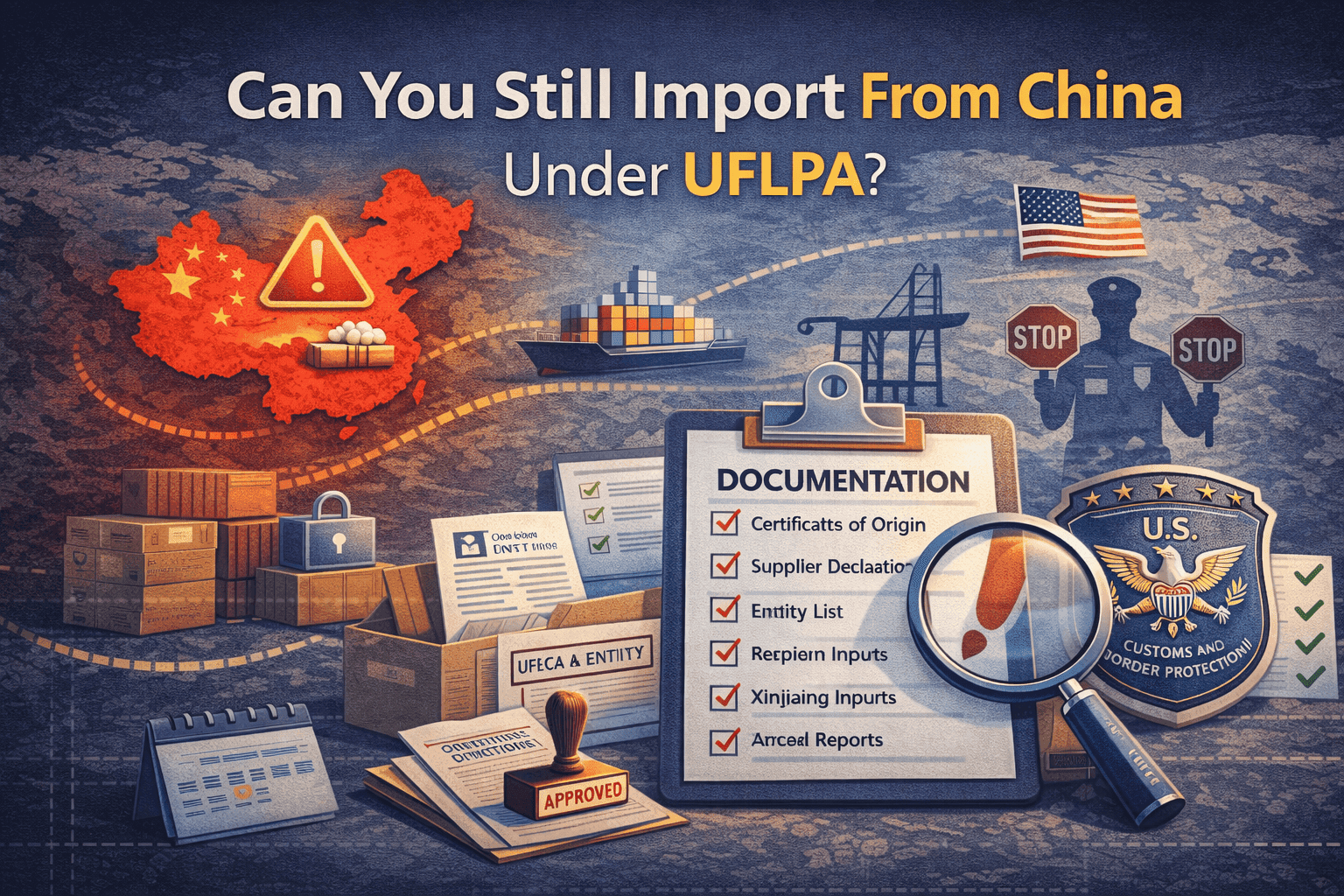
Can you still import from China under UFLPA? Yes—but the rules have changed dramatically.
Since the Uyghur Forced Labor Prevention Act took effect, many importers assume they need to abandon Chinese suppliers entirely. That’s not true.
What you need is visibility, documentation, and a screening process.
This guide explains exactly what’s still allowed, what’s changed, and how to import from China without getting detained.
The Short Answer: Yes, You Can Import From China
UFLPA doesn’t ban all Chinese imports. It specifically targets:
- Goods from Xinjiang (one region in northwestern China)
- Goods connected to UFLPA Entity List companies
- Goods made with forced labor anywhere in the supply chain
China has 34 provincial-level administrative divisions. Xinjiang is one. Goods from Guangdong, Zhejiang, Fujian, Shanghai, and other provinces are not automatically targeted.
What’s Changed for China Importers
Before UFLPA (Pre-2022)
- CBP had to prove goods were made with forced labor
- Withhold Release Orders (WROs) targeted specific companies
- Burden of proof was on CBP
- Limited enforcement capacity
After UFLPA (2022-Present)
- Goods from Xinjiang are presumed to involve forced labor
- Burden of proof shifted to importers
- CBP screens import data systematically
- Enforcement is proactive, not reactive
The fundamental shift: you’re guilty until proven innocent for anything connected to Xinjiang.
Products You Can Still Import From China
Low-Risk Products
Products with no typical Xinjiang connection:
- Electronics from Shenzhen/Guangdong (if no Xinjiang silicon)
- Machinery from eastern provinces
- Plastics and synthetics (non-silica based)
- Ceramics and glassware
- Metal products (non-aluminum from non-Xinjiang sources)
Medium-Risk Products (Need Documentation)
- Mixed-material products with partial cotton content
- Electronics with silicon components
- Processed food products
- Automotive parts with diverse material inputs
High-Risk Products (Significant Scrutiny)
- Cotton/textiles – 85% of Chinese cotton is from Xinjiang
- Polysilicon/solar – 45% of global polysilicon from Xinjiang
- Tomatoes – Major Xinjiang crop
- Human hair – Subject to WROs
Learn about specific industry risks: Apparel | Solar | Agriculture | Automotive
How to Safely Import From China Under UFLPA
1. Know Exactly Where Your Goods Come From
“Made in China” isn’t specific enough anymore. You need to know:
- Which province and city?
- Where do raw materials originate?
- Are any inputs from Xinjiang?
2. Screen Every Supplier
Before placing orders, check against:
- UFLPA Entity List
- OFAC SDN List
- Known Xinjiang-connected entities
VettedImport screens suppliers instantly with multi-algorithm matching that catches name variations manual searches miss.
3. Collect Documentation Upfront
Don’t wait for CBP to ask. Gather now:
- Certificates of Origin with specific location details
- Supplier declarations addressing UFLPA specifically
- Production records and batch tracing
- Sub-supplier information
4. Add UFLPA Clauses to Contracts
Include in supplier agreements:
- No Xinjiang-sourced materials without verification
- Obligation to disclose supply chain
- Right to audit
- Termination for non-compliance
5. Consider Dual Sourcing
For high-risk materials, develop alternative sources outside China:
- Reduces Xinjiang exposure
- Provides backup if suppliers are listed
- Demonstrates due diligence to CBP
Red Flags When Sourcing From China
Watch for these warning signs:
- Supplier won’t disclose location beyond “China”
- Unusually low prices for cotton, polysilicon, or tomatoes
- Supplier refuses to sign forced labor declarations
- Shipping routes through Xinjiang
- Evasive answers about sub-suppliers
- Certificates from trading companies rather than actual manufacturers
What Happens If You Get It Wrong
Detention Costs
- Port storage: $500-2,000+ per day
- Demurrage fees on containers
- Customer penalties for late delivery
- Legal costs for CBP response
Exclusion
If CBP denies entry, you lose the goods or pay to re-export them.
Reputation Damage
Future shipments face increased scrutiny. Once flagged, you’re on CBP’s radar.
FAQs About Importing From China Under UFLPA
Do I need to stop buying from Chinese suppliers?
No. You need to verify their location, screen against Entity Lists, and document the supply chain. Many Chinese suppliers outside Xinjiang are perfectly compliant.
What if my Chinese supplier says they’re not in Xinjiang?
Get it in writing, and verify. Request business registration documents showing their actual location. Cross-reference with public databases.
Are Alibaba and other marketplace purchases affected?
Yes. As the importer of record, you’re responsible for UFLPA compliance regardless of purchasing channel. Marketplace purchases often have less supply chain visibility.
What if I don’t know where materials come from?
That’s a problem. If CBP detains your goods and you can’t prove origin, you’ll likely lose them. Start building supply chain visibility now.
Is it safer to just avoid China entirely?
Not necessarily. Many non-China factories use Chinese raw materials. A Vietnamese garment factory using Chinese cotton has the same UFLPA risk. Focus on knowing your supply chain, not just avoiding a country.
How do I explain UFLPA requirements to my Chinese suppliers?
Frame it as a US market access requirement. Most sophisticated Chinese suppliers are already aware of UFLPA and have documentation ready. If they’re not willing to cooperate, consider that a warning sign.
The Bottom Line
You absolutely can still import from China under UFLPA. Millions of shipments clear US customs from China every month.
The difference between importers who succeed and those who get detained is preparation: screening suppliers, documenting supply chains, and knowing where goods actually come from.
Can you import from China under UFLPA? Yes—if you know your supply chain and can prove it.