

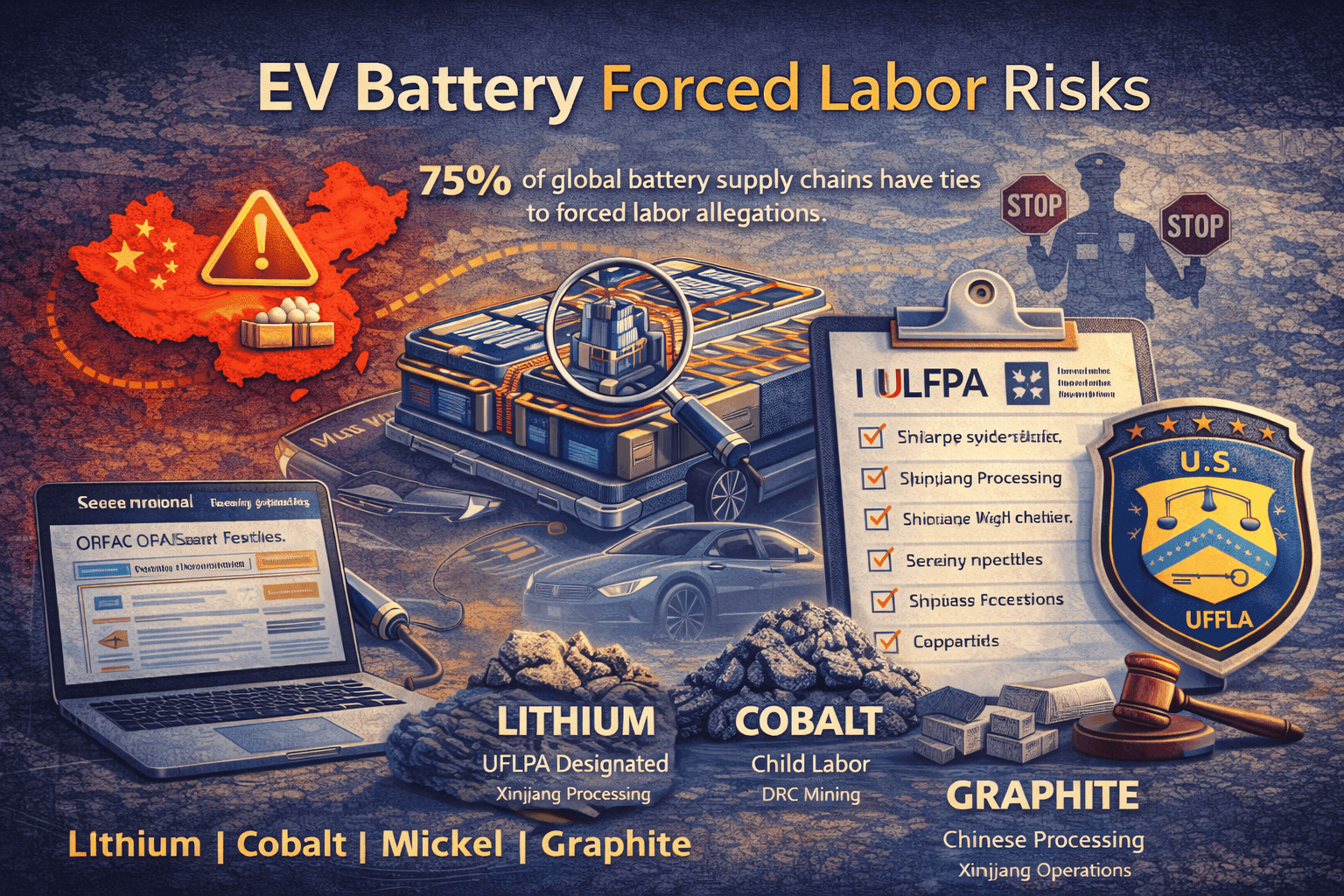
EV battery forced labor risks are putting the automotive industry squarely in CBP’s crosshairs—and most importers aren’t ready.
A 2025 study found that companies accounting for 75% of the global battery market have connections to supply chains facing allegations of severe human rights abuses (WardsAuto).
With lithium now designated as a UFLPA high-priority sector, the risk for EV and battery importers just intensified.
Why EV Batteries Are a Forced Labor Risk
EV batteries require multiple raw materials, each with its own risk profile:
Lithium
- China processes 65%+ of global lithium
- Xinjiang has expanding lithium processing capacity
- Lithium designated as UFLPA high-priority sector in August 2025 (DHS)
Cobalt
- 70% of global cobalt comes from the Democratic Republic of Congo
- Widespread child labor and forced labor in artisanal mining
- Chinese companies control significant DRC mining operations
- Congressional hearings have examined how China exploits forced labor in the Congo
Nickel
- Indonesia and the Philippines are major producers
- Labor rights concerns in Indonesian nickel processing
- Chinese-owned facilities in Indonesia face scrutiny
Graphite
- China produces 65% of natural graphite
- Xinjiang has graphite processing operations
The 2025 UFLPA Expansion: Lithium Joins the Priority List
The August 2025 UFLPA Strategy update changed everything for battery importers.
Lithium is now a designated high-priority sector alongside copper and steel (Kharon). This means:
- CBP is actively targeting lithium-containing imports
- New Entity List additions target lithium processors
- Enforcement resources are being directed at this sector
- Battery and EV imports face increasing scrutiny
What This Means for Auto and EV Importers
Battery Packs and Cells
If your batteries contain lithium processed in Xinjiang, they face UFLPA enforcement. This includes:
- Complete battery packs
- Individual battery cells
- Battery modules
- Lithium compounds and precursors
EV Components
The automotive sector faces compounding risk from multiple UFLPA priority materials:
- Lithium in batteries (new priority)
- Steel in frames and components (new priority)
- Copper in wiring and motors (new priority)
- Aluminum in bodies and parts (existing priority)
Consumer Electronics
Laptops, phones, and power tools using lithium-ion batteries also face increased scrutiny.
75% of Battery Supply Chains at Risk
According to research from supply chain intelligence firm Infyos, 75% of global battery supply chains have connections to companies facing allegations of human rights abuses (MHL News).
The types of abuses documented include:
- People forced to work in lithium refining facilities under threat
- Children as young as 5 mining cobalt in hazardous conditions
- Forced labor in Xinjiang-based mineral processing
- Worker exploitation in DRC artisanal mines
Most allegations involve companies mining and refining raw materials in China, particularly in Xinjiang.
Building a Compliant EV Battery Supply Chain
Step 1: Map Your Battery Supply Chain
Trace each critical mineral from mine to battery:
- Where is lithium mined? Where is it processed?
- Where does cobalt originate? Through what intermediaries?
- Who manufactures cathode/anode materials?
- Where are cells assembled?
Step 2: Screen All Suppliers
Check every supply chain participant against:
- UFLPA Entity List (144 entities)
- OFAC SDN List
- Known Xinjiang-connected processors
VettedImport screens against all major watch lists with fuzzy matching that catches name variations.
Step 3: Require Traceability
Implement mineral traceability requirements:
- Blockchain-based tracking systems
- Third-party chain-of-custody certification
- Isotopic testing for material origin verification
Step 4: Audit Critical Suppliers
Prioritize third-party audits for:
- Lithium processors (especially China-based)
- Cobalt suppliers (DRC-sourced)
- Any supplier in Xinjiang or with XPCC connections
Step 5: Diversify Sources
Build alternative supply relationships:
- Lithium: Chile, Australia, Argentina
- Cobalt: Australia, Philippines (certified sources)
- Nickel: Canada, Australia
- Battery cells: South Korea, Japan, US domestic
Global Regulations Are Converging
It’s not just UFLPA. The EU Battery Regulation (effective 2025-2036) requires supply chain due diligence and carbon footprint declarations for batteries entering the European market.
Building compliance now prepares you for multiple regulatory requirements across jurisdictions.
FAQs About EV Battery Forced Labor
Are all Chinese batteries subject to UFLPA?
Not all, but batteries containing lithium processed in Xinjiang or from Entity List companies are. The challenge is proving your lithium wasn’t processed there.
Do Tesla and other EV makers face UFLPA risk?
All EV importers face potential risk depending on their battery supply chains. Major manufacturers have been investing in supply chain traceability to address this.
What about batteries in consumer electronics?
Same rules apply. Laptops, phones, and power tools with lithium-ion batteries face the same UFLPA scrutiny as EV batteries.
Can I prove my lithium is clean?
Yes, with documentation: certificates of origin for lithium, processing records, supplier declarations, and ideally third-party verification of the supply chain.
When will enforcement ramp up for lithium?
It’s already beginning. With the August 2025 priority designation, expect significant enforcement activity throughout 2026.
The Bottom Line
EV battery supply chains are the next frontier of forced labor enforcement.
With lithium, copper, and steel all designated as UFLPA priority sectors, the automotive industry faces unprecedented compliance requirements.
Start mapping your battery supply chain, screening suppliers, and building documentation now—before enforcement catches up to your shipments.
EV battery forced labor risks are real and growing—importers who act now will avoid the costly detentions coming in 2026 and beyond.