

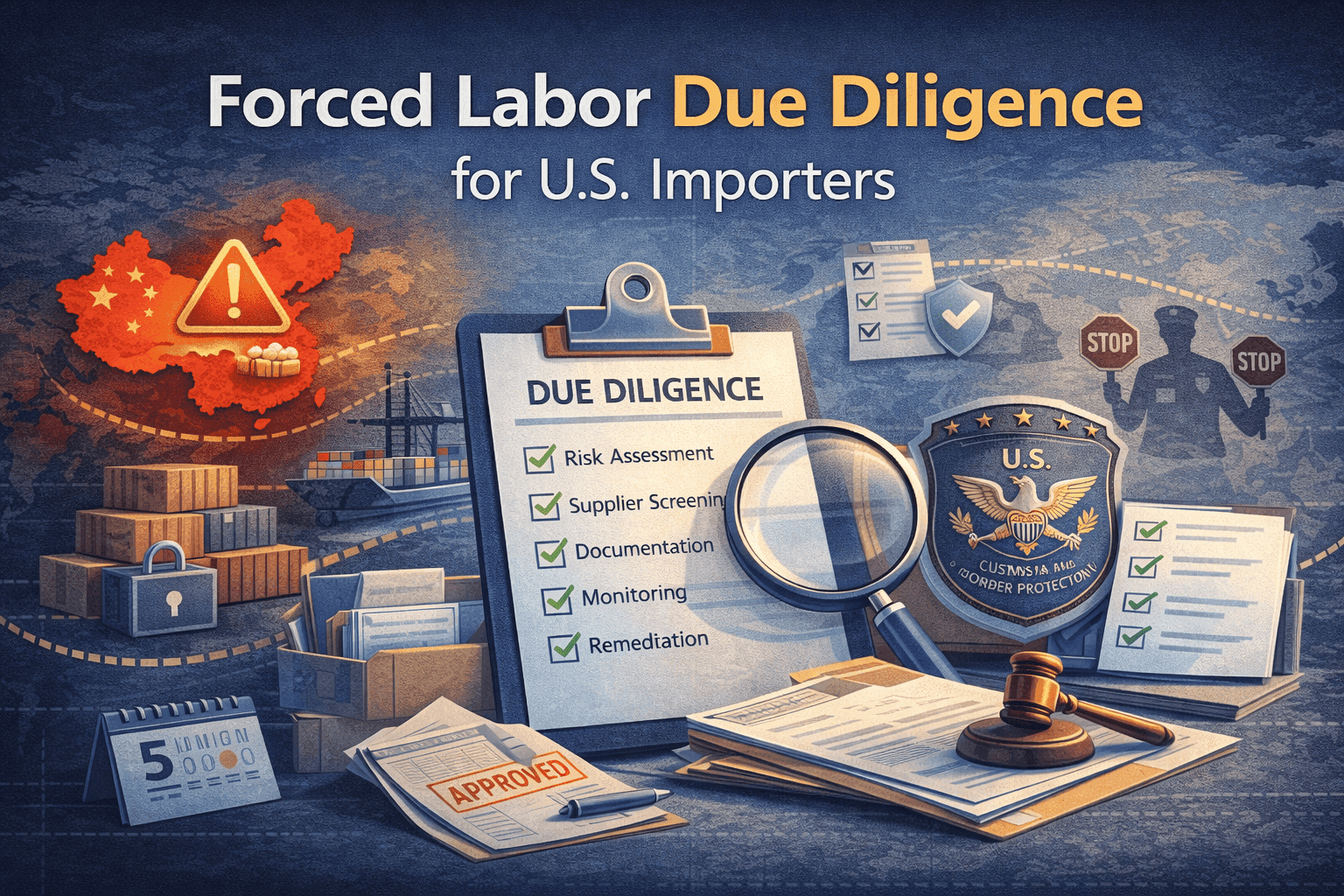
Forced labor due diligence is no longer a corporate social responsibility checkbox—it’s a legal requirement for US importers.
Since the UFLPA took effect in 2022, CBP has detained billions in goods from importers who couldn’t prove their supply chains were clean.
This guide shows you how to build a forced labor due diligence program that actually works—one that protects your shipments, satisfies CBP, and doesn’t require a Fortune 500 compliance budget.
What is Forced Labor Due Diligence?
Forced labor due diligence is the process of identifying, preventing, and addressing forced labor risks in your supply chain.
For US importers, this primarily means:
- Screening suppliers against the UFLPA Entity List and OFAC sanctions
- Mapping your supply chain to identify Xinjiang connections
- Collecting documentation proving goods are free from forced labor
- Maintaining ongoing monitoring as regulations evolve
Why Due Diligence Matters Now More Than Ever
UFLPA Enforcement is Intensifying
CBP has dramatically ramped up enforcement since 2022:
- 8,000+ shipments reviewed under UFLPA
- $3+ billion in goods detained
- New entities added to watch lists regularly
- Expanded industries under scrutiny beyond cotton and solar
Global Regulations Are Converging
The US isn’t alone. The EU Corporate Sustainability Due Diligence Directive (CSDDD) and Canada’s forced labor import ban mean due diligence is becoming a global standard.
Building your program now prepares you for multiple regulatory requirements.
The 6-Step Due Diligence Framework
Step 1: Risk Assessment
Start by identifying where forced labor risk exists in your supply chain.
High-Risk Indicators
- Geography: Sourcing from or through China, especially Xinjiang
- Industry: Cotton, polysilicon, tomatoes, electronics, human hair products
- Supply chain complexity: Multiple tiers, blended materials, commodity inputs
- Supplier transparency: Suppliers unwilling to disclose sub-suppliers
Risk Mapping Exercise
For each product you import, answer:
- Where are raw materials sourced?
- Where does processing/manufacturing occur?
- How many tiers exist between raw materials and finished goods?
- Are any components from China or countries that process Chinese materials?
Step 2: Supplier Screening
Screen every supplier—not just tier-1—against relevant watch lists.
Essential Screening Lists
- UFLPA Entity List (DHS) – Forced labor in Xinjiang
- OFAC SDN List (Treasury) – Sanctioned entities
- BIS Entity List (Commerce) – Export restrictions
VettedImport screens against all major watch lists in seconds, matching against name variations and aliases that manual searches miss.
Screening Best Practices
- Screen before placing orders (not after)
- Re-screen when watch lists update
- Screen sub-suppliers, not just direct vendors
- Document all screening results
Step 3: Supply Chain Mapping
You can’t manage what you can’t see. Map your supply chain from finished goods back to raw materials.
What to Document
- Entity name and address at each tier
- Country and region (province/city for China)
- What they provide (raw material, processing, assembly)
- Who they source from
Going Beyond Tier-1
Most importers know their direct suppliers. The risk usually hides deeper:
- Tier-1: Your direct supplier (factory)
- Tier-2: Their material suppliers (fabric mill, component maker)
- Tier-3: Raw material sources (cotton farm, silicon producer)
UFLPA enforcement targets connections at any tier. A clean factory using materials from a listed entity puts your goods at risk.
Step 4: Documentation Collection
Documentation is your proof of due diligence. Collect and organize:
Core Documents
- Supplier declarations – Written statements confirming no forced labor or Xinjiang connections
- Certificates of Origin – Verifying where goods and materials originated
- Production records – Purchase orders, invoices, batch records linking specific shipments to claimed origins
- Audit reports – Third-party verification of supplier practices
Learn more about the essential documents for UFLPA compliance.
Documentation Standards
- Be specific (not just “Made in China” — which province?)
- Be current (documents should be recent, ideally within 12 months)
- Be consistent (dates, quantities, and names should match across documents)
- Be organized (you may need to produce these quickly for CBP)
Step 5: Remediation and Decision-Making
When screening or mapping reveals risks, you need a clear decision framework.
Decision Matrix
Entity List match: Do not proceed. Find alternative suppliers.
Xinjiang connection identified: Pause orders. Request documentation proving non-forced labor origin. If unavailable, terminate relationship.
Incomplete supply chain visibility: Request more information. Set deadlines. Escalate if suppliers refuse transparency.
Third-country processing of Chinese materials: Trace materials to origin. Require documentation at every tier.
Step 6: Ongoing Monitoring
Due diligence isn’t a one-time project. It requires continuous attention.
What to Monitor
- Watch list updates – New entities added to UFLPA/OFAC lists
- Supplier changes – New sub-suppliers, facility changes, ownership changes
- Regulatory changes – New guidance from CBP, new laws, enforcement priorities
- Industry developments – New sectors targeted, enforcement trends
Monitoring Frequency
- Watch list screening: Continuous (automated) or quarterly (manual minimum)
- Supply chain reviews: Semi-annually
- Documentation updates: Annually or when supply chain changes
- Policy reviews: Annually
Due Diligence for SMBs: Practical Approach
You don’t need a 50-person compliance team to do this right.
Start Small, Start Now
- Week 1: Screen all current suppliers against Entity List and OFAC
- Week 2: Request supplier declarations from high-risk suppliers
- Week 3: Map supply chains for your top products
- Week 4: Organize documentation and identify gaps
Use Technology to Scale
Manual due diligence doesn’t scale. VettedImport helps SMB importers:
- Screen suppliers against all major watch lists automatically
- Organize compliance documentation in one place
- Generate CBP-ready compliance packs
- Monitor for watch list updates
Start screening your suppliers for free.
Common Due Diligence Mistakes
1. Only Screening Tier-1 Suppliers
Your direct supplier may be clean, but their sources might not be. UFLPA enforcement follows materials, not just company names.
2. Accepting Generic Declarations
“We comply with all labor laws” isn’t specific enough. Declarations should name UFLPA, mention Xinjiang, and include supply chain details.
3. Set-It-and-Forget-It Mentality
Due diligence requires ongoing attention. Watch lists change, suppliers change, regulations evolve.
4. No Documentation
If you did the work but didn’t document it, CBP won’t give you credit. Keep records of all screening, communications, and decisions.
5. Waiting for a Detention
Building documentation after detention is exponentially harder than collecting it proactively. Start before you need it.
FAQs About Forced Labor Due Diligence
Is forced labor due diligence legally required?
Under UFLPA, importers must demonstrate their goods are not made with forced labor if CBP requests evidence. While the law doesn’t mandate a specific program, having one is the only practical way to comply.
How much does a due diligence program cost?
For SMBs, basic screening and documentation can start at minimal cost with tools like VettedImport. The cost of NOT having a program—detention fees, lost goods, legal costs—far exceeds prevention.
Do I need to audit every supplier?
No. Prioritize audits for high-risk suppliers (those in China, in high-risk industries, or with limited transparency). Use a risk-based approach.
What if a supplier refuses to provide information?
That’s a red flag. Document the refusal and consider it in your risk assessment. Suppliers who won’t disclose their supply chain may be hiding something.
How do I prove “clear and convincing evidence” to CBP?
Through comprehensive documentation: supply chain maps, origin certificates, supplier declarations, production records, and ideally third-party audits. The more complete your package, the stronger your case.
Does due diligence protect me from all UFLPA risk?
No program eliminates all risk. But a documented due diligence program demonstrates good faith, makes detention responses faster, and significantly reduces the likelihood of exclusion.
The Bottom Line on Forced Labor Due Diligence
Forced labor due diligence is the cost of doing business as a US importer in 2026.
The good news: most of the work is upfront. Once you’ve built your program, maintaining it is manageable—especially with the right tools.
The importers who invest in due diligence now will import with confidence while competitors scramble to respond to detentions.
Building a forced labor due diligence program isn’t just about compliance—it’s about building a resilient, trustworthy supply chain.