

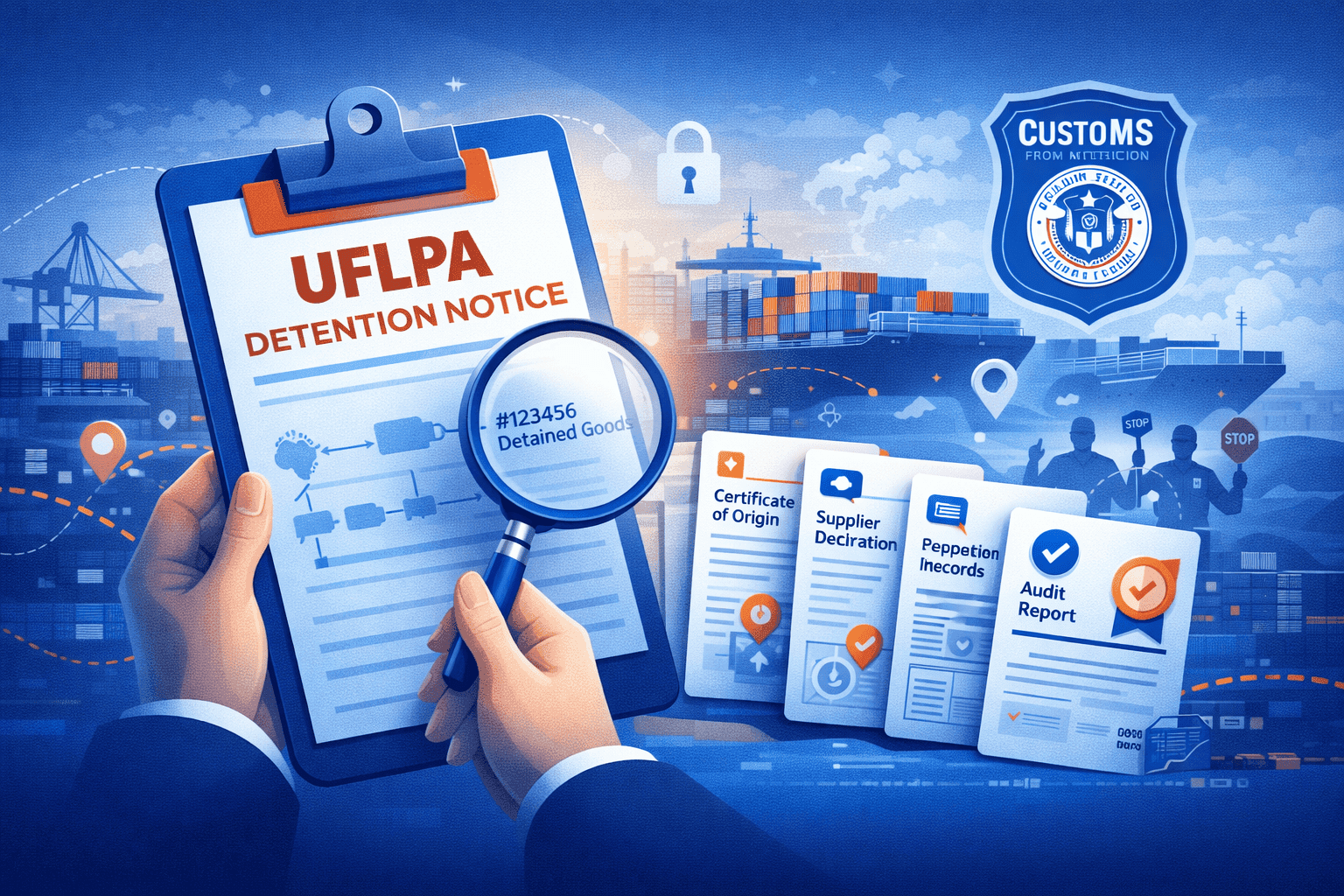
Receiving a UFLPA detention notice from CBP can feel overwhelming. Your goods are sitting at the port, deadlines are ticking, and customers are waiting. But with the right approach and documentation, many importers successfully overcome detentions and get their goods released.
Here’s your complete guide to responding to a UFLPA detention.
Understanding the Detention Notice
When CBP detains goods under UFLPA, you’ll receive a “Notice of Detention” that includes:
- Entry number and date
- Description of goods detained
- Reason for detention (usually suspected Xinjiang origin or Entity List connection)
- Deadline to respond (typically 5 business days for initial response)
Read this notice carefully. The specific reason for detention guides your response strategy.
The UFLPA Detention Timeline
Time is critical. Here’s what to expect:
| Day | Action |
|---|---|
| Day 0 | Receive detention notice |
| Day 5 | Initial response due (extension possible) |
| Day 30 | Full evidence submission deadline |
| Day 30-60 | CBP review period |
| After review | Release, seizure, or redelivery decision |
Pro tip: Request an extension early if you need more time. CBP often grants reasonable extensions for complex supply chains.
Step 1: Assess Your Position (Day 1)
Before responding, honestly evaluate your situation:
Questions to Ask
- Do you have existing documentation proving non-Xinjiang origin?
- Are any of your suppliers on the UFLPA Entity List?
- Can you trace raw materials to their source?
- Do you have third-party audit reports?
If you have strong documentation, you’re in good shape. If not, you’ll need to work quickly to gather evidence.
Step 2: Contact Your Suppliers Immediately (Days 1-3)
Your suppliers are your primary source of evidence. Request:
- Supplier declarations stating goods are not from Xinjiang
- Origin certificates for raw materials
- Production records showing manufacturing location
- Subcontractor information if they use third parties
- Any existing audit reports on forced labor compliance
Be specific about what you need. Vague requests lead to vague responses.
Step 3: Compile Your Evidence Package (Days 3-15)
CBP wants to see a complete picture of your supply chain. Your evidence package should include:
Required Documentation
1. Supply Chain Mapping
A clear diagram showing:
- Raw material sources
- Intermediate processors
- Final manufacturer
- Export path to US
2. Origin Evidence
- Certificates of Origin
- Country of Origin markings
- Manufacturing location documentation
3. Supplier Attestations
Written declarations from each supply chain participant confirming:
- No Xinjiang-sourced materials
- No use of forced labor
- Compliance with labor laws
4. Traceability Records
- Purchase orders and invoices
- Shipping documents
- Production records
- Lot/batch tracking
5. Due Diligence Evidence
- Supplier audit reports
- Social compliance certifications
- Screening records against Entity List
Step 4: Submit Your Response
Your formal response should include:
- Cover letter summarizing your position and evidence
- Organized evidence package with clear indexing
- Supply chain narrative explaining the journey of your goods
- Any expert declarations if applicable
Submit through the CBP portal or as directed in your detention notice.
What Makes a Successful Response?
Based on CBP guidance and successful releases, winning responses typically have:
Clear and Convincing Evidence
Remember, you’re overcoming a presumption. Vague assertions won’t work. You need concrete documentation.
Complete Supply Chain Visibility
Gaps in your supply chain map raise red flags. Even if you can’t trace to raw materials, explain why and provide what you can.
Third-Party Verification
Independent audits and certifications carry more weight than supplier self-declarations alone.
Consistency Across Documents
Dates, quantities, and supplier names should match across all documents. Inconsistencies undermine credibility.
Common Mistakes to Avoid
1. Missing the deadline
Extensions exist for a reason. If you can’t meet a deadline, request an extension before it passes.
2. Submitting incomplete packages
Better to request an extension than submit a weak initial package. CBP forms impressions quickly.
3. Generic supplier declarations
“We don’t use forced labor” isn’t enough. Declarations should specifically address Xinjiang and include supply chain details.
4. Ignoring sub-suppliers
If your supplier sources from subcontractors, you need documentation about them too.
5. Contradictory evidence
Review all documents for consistency before submission. Contradictions can sink otherwise strong cases.
What Happens After Submission?
After you submit evidence, CBP will:
- Review your package (typically 30-60 days)
- May request additional information (respond promptly)
- Make a determination:
- Release: Goods cleared for import
- Exclusion: Goods denied entry
- Seizure: Goods seized pending further action
If excluded, you typically have the option to export the goods rather than having them seized.
How to Prevent Future Detentions
The best detention response is prevention. After resolving a detention:
- Document lessons learned
- Screen new suppliers against the Entity List before ordering
- Require compliance documentation in supplier contracts
- Conduct or require audits for high-risk suppliers
- Use compliance tools to monitor your supply chain
The Proactive Approach
Smart importers don’t wait for detentions. They:
- Screen suppliers before placing orders
- Collect compliance documentation upfront
- Maintain organized records for quick response
- Monitor the Entity List for changes
VettedImport helps importers do all of this automatically, turning potential crises into routine compliance.
Facing a detention or want to prevent one? VettedImport helps you screen suppliers and organize compliance documentation before you need it. Get started free.