

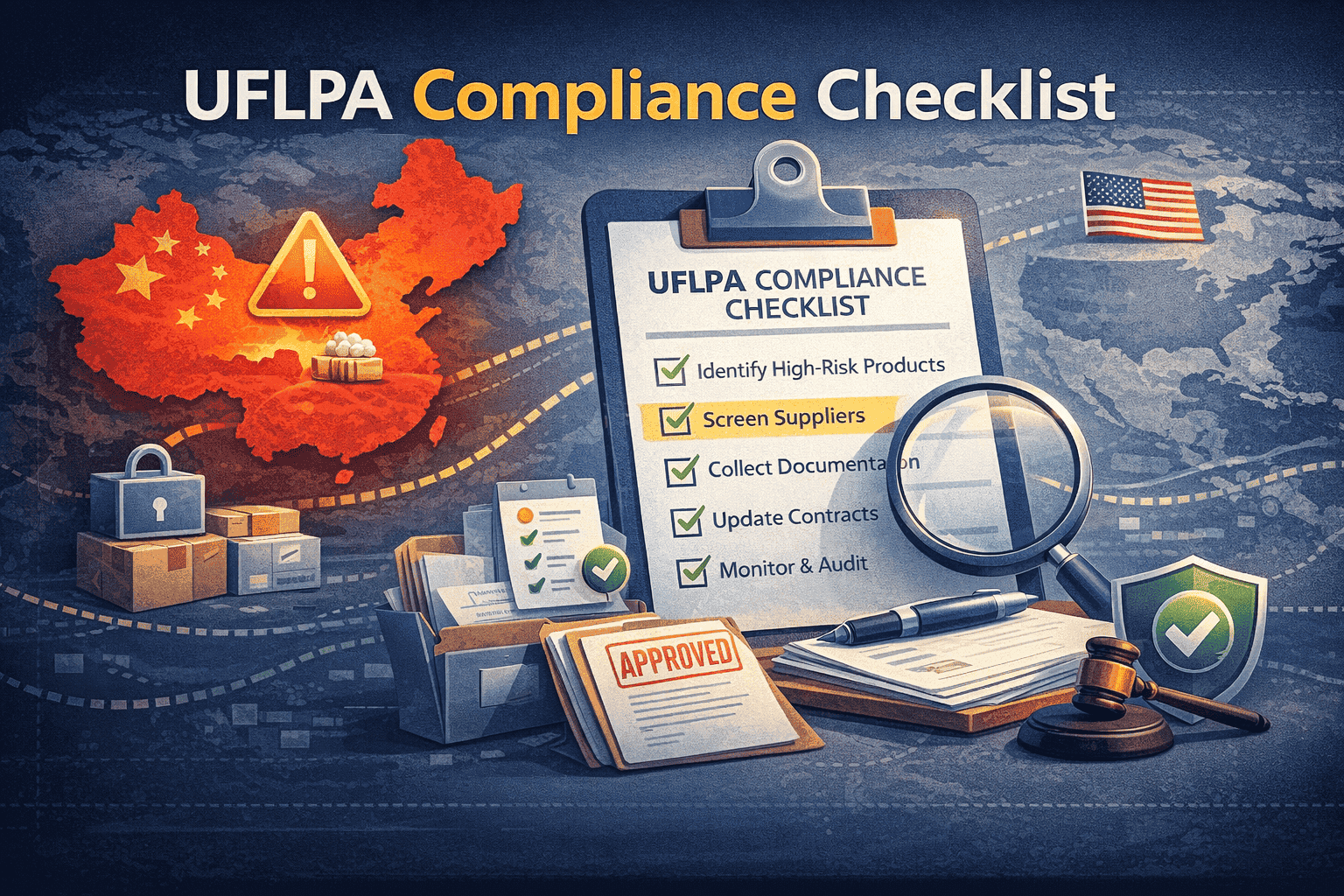
How to respond to CBP detention under UFLPA can mean the difference between releasing your goods and losing your entire shipment.
Your goods are sitting at the port. The clock is ticking. Customers are waiting.
This guide walks you through exactly what to do—step by step—when CBP detains your shipment under the Uyghur Forced Labor Prevention Act.
Understanding the UFLPA Detention Process
When CBP suspects your goods have connections to Xinjiang or the UFLPA Entity List, they issue a detention.
Under UFLPA’s “rebuttable presumption,” your goods are presumed to be made with forced labor until you prove otherwise.
The burden is on you—the importer—to provide “clear and convincing evidence” that your goods are clean.
The Detention Timeline
Time is critical. Here’s what to expect:
| Timeline | Action Required |
|---|---|
| Day 0 | Receive detention notice from CBP |
| Day 5 | Initial response due (extension possible) |
| Day 30 | Full evidence submission deadline |
| Day 30-60 | CBP review period |
| After review | Decision: Release, Exclusion, or Seizure |
Critical: If you need more time, request an extension BEFORE the deadline passes. CBP often grants reasonable extensions for complex supply chains.
Step 1: Receive and Review the Detention Notice (Day 0)
Your detention notice will include:
- Entry number and date
- Description of detained goods
- Reason for detention (usually suspected Xinjiang origin or Entity List connection)
- Response deadline
- Contact information for the CBP port
Immediate Actions
- Read the notice carefully – Understand exactly why CBP detained your goods
- Note all deadlines – Mark them on your calendar
- Notify your customs broker – They should already know, but confirm
- Contact your supplier – You’ll need documentation from them fast
Step 2: Assess Your Position (Days 1-2)
Before responding, honestly evaluate your situation:
Questions to Answer
- Do you have existing documentation proving non-Xinjiang origin?
- Are any of your suppliers on the UFLPA Entity List?
- Can you trace raw materials to their source?
- Do you have third-party audit reports?
- How strong is your evidence?
Possible Scenarios
Best case: You have solid documentation and can quickly compile a response.
Moderate case: You have some documentation but need to gather more from suppliers.
Challenging case: You have limited visibility into your supply chain and need to build documentation from scratch.
Step 3: Contact Suppliers Immediately (Days 1-3)
Your suppliers are your primary source of evidence. Contact them immediately requesting:
Documentation to Request
- Supplier declarations – Written statements confirming goods are not from Xinjiang
- Certificates of origin – For raw materials, not just finished goods
- Production records – Showing where manufacturing occurred
- Subcontractor information – If they use third parties
- Any existing audit reports – Social compliance, supply chain audits
How to Ask
Be specific. Don’t just ask for “documentation.” Explain:
- What you need
- Why you need it (CBP detention)
- The deadline
- Exact format requirements
Vague requests lead to vague responses that won’t help your case.
Step 4: Compile Your Evidence Package (Days 3-15)
CBP wants a complete picture of your supply chain. Your evidence package should include:
1. Supply Chain Map
A clear diagram showing:
- Raw material sources (specific locations)
- Processing facilities
- Intermediate manufacturers
- Final manufacturer
- Export path to US
2. Origin Evidence
- Certificates of Origin (for raw materials, not just finished goods)
- Country of Origin markings
- Manufacturing location documentation
- Specific region/province information
3. Supplier Attestations
Written declarations from each supply chain participant confirming:
- No Xinjiang-sourced materials
- No use of forced labor
- Compliance with labor laws
- Specific details about their sourcing
4. Traceability Records
- Purchase orders between supply chain parties
- Commercial invoices with matching quantities/dates
- Bills of lading showing shipping routes
- Production batch records
- Lot/batch tracking documentation
5. Due Diligence Evidence
- Supplier screening records (Entity List, OFAC checks)
- Third-party audit reports
- Social compliance certifications
- Your company’s compliance policies
Step 5: Submit Your Response
Your formal response should include:
- Cover letter – Summarizing your position and evidence
- Evidence index – Listing all attached documents
- Supply chain narrative – Explaining the journey of your goods
- Organized evidence package – With clear labeling
- Any expert declarations – If applicable
Submit through the method specified in your detention notice (usually CBP portal or email).
What Makes a Successful Response?
Based on CBP guidance and successful releases, winning responses typically have:
Clear and Convincing Evidence
Remember, you’re overcoming a presumption. Vague assertions don’t work. You need concrete documentation.
Complete Supply Chain Visibility
Gaps in your supply chain map raise red flags. Even if you can’t trace to raw materials, explain why and provide what you can.
Third-Party Verification
Independent audits and certifications carry more weight than supplier self-declarations alone.
Consistency Across Documents
Dates, quantities, and supplier names should match across all documents. Inconsistencies undermine credibility.
Professional Presentation
Organized, clearly labeled, easy to review. Make CBP’s job easy.
Common Mistakes to Avoid
Missing Deadlines
Extensions exist for a reason. If you can’t meet a deadline, request an extension BEFORE it passes.
Submitting Incomplete Packages
Better to request an extension than submit a weak initial package. First impressions matter.
Generic Supplier Declarations
“We don’t use forced labor” isn’t enough. Declarations should specifically address Xinjiang and include supply chain details.
Ignoring Sub-Suppliers
If your direct supplier sources from subcontractors, you need documentation about them too. CBP knows supply chains have multiple tiers.
Contradictory Evidence
Review all documents for consistency before submission. Contradictions can sink otherwise strong cases.
Emotional Appeals
Stick to facts and evidence. Arguments about business hardship or good intentions don’t overcome the legal presumption.
What Happens After Submission?
After you submit evidence, CBP will:
- Review your package (typically 30-60 days)
- May request additional information – Respond promptly
- Make a determination
Possible Outcomes
Release: Goods cleared for import. Best outcome.
Exclusion: Goods denied entry. You can typically export them (at your cost) rather than having them seized.
Seizure: Goods seized. May lead to forfeiture proceedings.
If Your Goods Are Excluded
Exclusion isn’t the end. You typically have options:
- Export the goods – Ship them to another country
- Appeal the decision – If you have additional evidence
- Request reconsideration – With new documentation
Consult with a customs attorney if you’re considering appeals.
Preventing Future Detentions
The best detention response is prevention. After resolving a detention:
- Document lessons learned – What was missing? What worked?
- Screen new suppliers before ordering
- Require compliance documentation upfront, not after detention
- Build relationships with verified suppliers
- Consider alternative sourcing for high-risk materials
Learn more about the UFLPA compliance challenge and how to build a prevention-focused program.
Tools for Detention Prevention and Response
VettedImport helps importers:
- Screen suppliers against Entity List and OFAC before ordering
- Organize documentation for quick access during detentions
- Generate compliance reports demonstrating due diligence
- Monitor for sanctions list updates affecting your suppliers
The time to prepare is before detention, not after.
FAQs About CBP UFLPA Detention
Can I get an extension on the response deadline?
Yes, CBP often grants reasonable extensions. Request in writing before the deadline passes, explaining why you need more time.
Do I need a lawyer for a detention response?
Not always, but legal counsel helps for complex cases, high-value shipments, or if your initial response is rejected.
What if my supplier won’t provide documentation?
This is a serious problem. Document your requests and their refusal. Consider whether this supplier relationship is worth the risk going forward.
How much does detention cost?
Port storage fees typically run $500-2,000+ per day. Add potential demurrage, lost sales, and customer penalties. Detentions easily cost tens of thousands of dollars.
Can CBP detain goods multiple times?
Yes. Each shipment is evaluated independently. Successfully releasing one shipment doesn’t prevent future detentions.
What if I genuinely don’t know my supply chain origins?
This is increasingly common—and increasingly problematic. Be honest with CBP, provide what documentation you can, and start building better supply chain visibility immediately.
The Bottom Line on CBP Detention Response
Responding to a UFLPA detention is stressful, but importers succeed every day by providing solid documentation and complete supply chain evidence.
The key is speed, organization, and thoroughness.
And the best response strategy? Don’t get detained in the first place.
Build your compliance program now—screen suppliers, collect documentation, and know your supply chain before CBP asks questions.
Knowing how to respond to CBP detention under UFLPA is essential, but prevention is always better than reaction.