

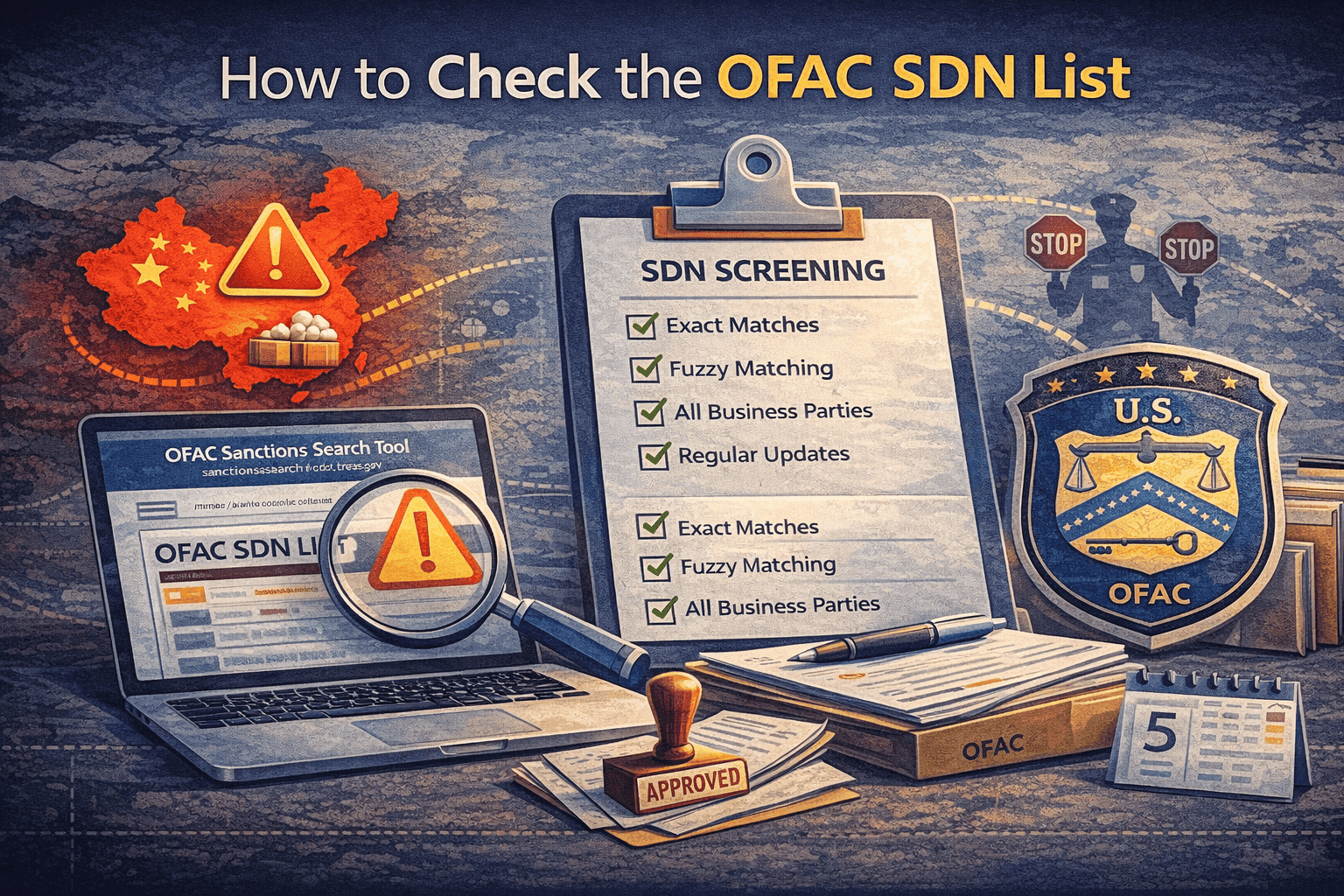
Knowing how to check the OFAC SDN list is essential for every US importer—missing a match can mean million-dollar penalties.
While most importers focus on UFLPA, OFAC sanctions carry some of the most severe penalties in US trade law.
This guide shows you how to screen suppliers against the SDN list, understand what a match means, and protect your business.
What is the OFAC SDN List?
The Specially Designated Nationals and Blocked Persons List (SDN List) is maintained by the Treasury Department’s Office of Foreign Assets Control (OFAC).
It identifies individuals and entities that US persons are prohibited from doing business with.
What Gets You Listed
- Terrorism financing
- Drug trafficking
- Weapons proliferation
- Human rights abuses (including forced labor)
- Cyberattacks
- Foreign government actions contrary to US interests
SDN List vs. UFLPA Entity List
| Feature | SDN List | UFLPA Entity List |
|---|---|---|
| Agency | Treasury (OFAC) | DHS (FLETF) |
| Focus | Broad sanctions | Forced labor (Xinjiang) |
| Consequence | Asset freezing, criminal penalties | Goods detained/excluded |
| Penalties | Up to $20M+ and criminal liability | Loss of goods, storage fees |
| Scope | All transactions | Imports only |
Key point: OFAC penalties are more severe than UFLPA. SDN violations can result in criminal prosecution, not just losing a shipment.
How to Check the OFAC SDN List
Method 1: OFAC Sanctions Search Tool
OFAC provides a free search tool at sanctionssearch.ofac.treas.gov.
Pros:
- Free and official
- Always current
Cons:
- One name at a time
- No batch screening
- Exact match only (misses variations)
- No monitoring or alerts
Method 2: Automated Screening Tools
VettedImport screens against both OFAC SDN and UFLPA Entity List simultaneously:
Advantages:
- Batch screening for all suppliers
- Fuzzy matching catches name variations
- Screens UFLPA + OFAC together
- Monitoring and alerts for updates
- Documentation of all screening
Method 3: Download the Full List
You can download the complete SDN List from OFAC’s website in various formats (XML, CSV, PDF).
This allows internal matching but requires:
- Regular updates (list changes frequently)
- Matching logic for name variations
- Technical expertise to implement
What to Do If You Find a Match
Exact Match
Stop immediately. Do not proceed with any transaction. Contact legal counsel.
Partial or Possible Match
- Verify with additional identifying information (address, date of birth, registration number)
- Check OFAC’s guidance on “false positive” resolution
- Document your verification process
- If uncertain, err on the side of caution
No Match
- Document that screening was performed
- Note the date and lists checked
- Schedule re-screening for future dates
Common OFAC Screening Mistakes
1. Screening Only at Onboarding
The SDN list updates frequently. A supplier clean last month might be sanctioned today. Screen regularly.
2. Exact Name Matches Only
Chinese names have multiple transliterations. “Xinjiang Daqo” might appear as “Daqo New Energy” or “大全新能源.” Use fuzzy matching.
3. Ignoring Affiliated Entities
Sanctions often cover subsidiaries and affiliates. A parent company on the SDN list means its subsidiaries are also restricted.
4. Not Documenting Screening
If OFAC investigates, you need to show you had a compliance program. Undocumented screening is effectively no screening.
5. Only Checking SDN
OFAC maintains multiple lists beyond SDN. Also check: Sectoral Sanctions, Foreign Sanctions Evaders, and Non-SDN lists.
OFAC Compliance for Importers: Best Practices
- Screen before transacting – Check new suppliers before placing orders
- Re-screen regularly – Monthly at minimum, automated if possible
- Use fuzzy matching – Don’t rely on exact name matches
- Screen all parties – Suppliers, manufacturers, banks, shipping companies
- Document everything – Keep records of all screening activity
- Train your team – Purchasing staff should know basic sanctions red flags
- Escalate matches – Have a clear process for handling potential matches
Screen your suppliers against OFAC and UFLPA for free with VettedImport.
FAQs About OFAC SDN List Screening
Is OFAC screening legally required?
While no law explicitly mandates screening, OFAC holds that all US persons are responsible for ensuring they don’t violate sanctions. Ignorance is not a defense. Screening is the only practical way to comply.
What are the penalties for OFAC violations?
Civil penalties up to approximately $330,000 per violation (adjusted annually) or twice the transaction amount. Criminal penalties can reach $20 million and 30 years imprisonment for willful violations.
How often is the SDN list updated?
Frequently—sometimes multiple times per week. There’s no fixed schedule. OFAC adds and removes entities as situations evolve.
Do I need to screen domestic suppliers too?
OFAC sanctions apply to all transactions, not just international ones. Screen any party you do significant business with, especially if they have foreign connections.
What’s the difference between SDN and non-SDN lists?
SDN is the primary blocked persons list. Non-SDN lists (like the Sectoral Sanctions list) have different restrictions—typically prohibiting certain types of transactions rather than all transactions.
Can I get permission to transact with an SDN entity?
You can apply for a specific license from OFAC. These are rarely granted and the process is lengthy. For most importers, finding alternative suppliers is far easier.
The Bottom Line on OFAC SDN Screening
OFAC screening is one of the simplest yet most important compliance steps an importer can take.
The penalties for getting it wrong are severe—potentially business-ending. The cost of screening is minimal.
Combined with UFLPA Entity List screening, regular OFAC checks form the foundation of any import compliance program.
Checking the OFAC SDN list should be the first step in evaluating any new supplier—the consequences of skipping it aren’t worth the risk.