

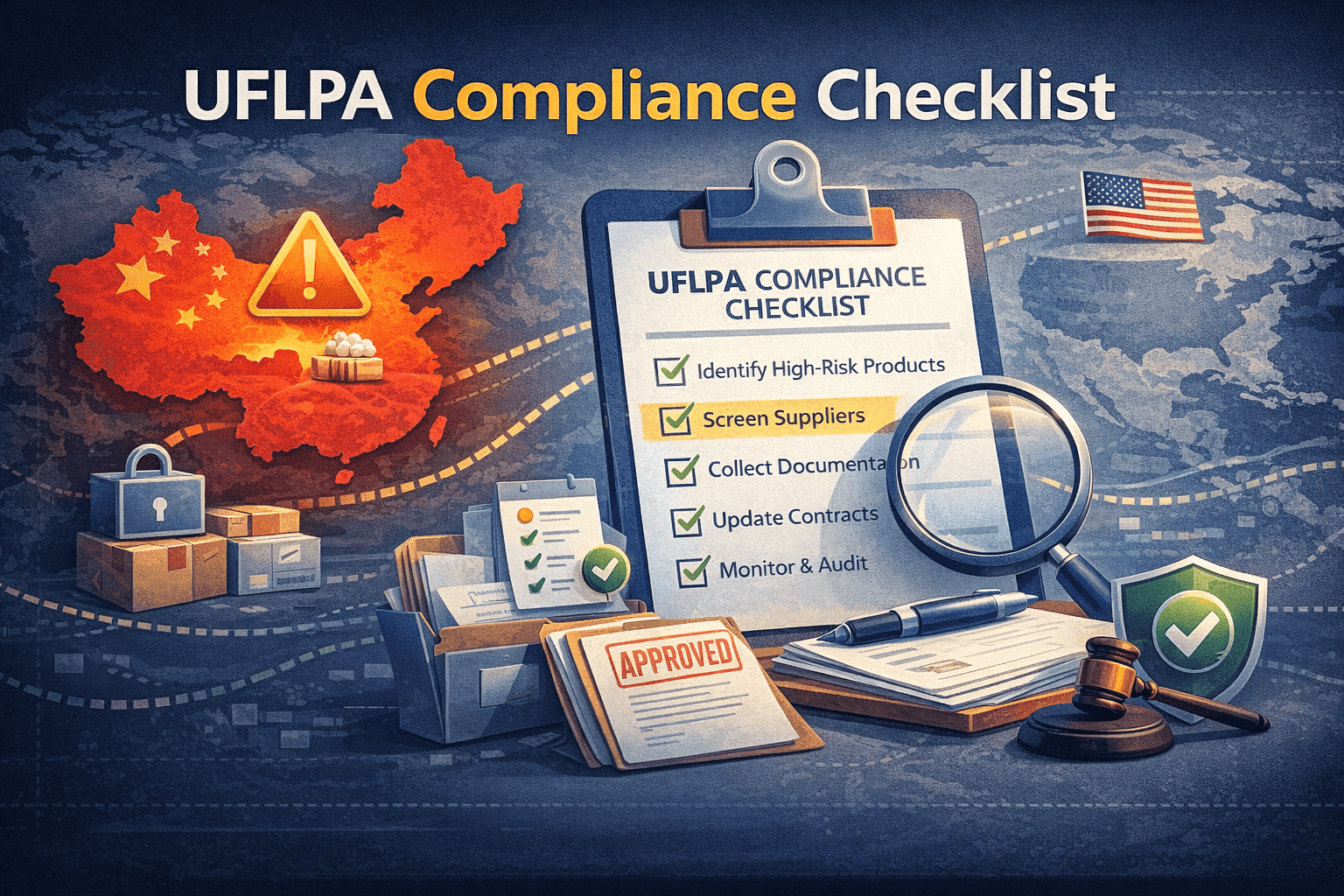
UFLPA compliance isn’t optional—it’s a requirement for any importer sourcing from China or countries that process Chinese materials.
But where do you start?
This checklist breaks down exactly what you need to do to protect your business from CBP detentions and forced labor enforcement.
Follow these steps to build a compliance program that actually works.
Why You Need a UFLPA Compliance Program
The Uyghur Forced Labor Prevention Act creates a “rebuttable presumption” that goods from Xinjiang are made with forced labor.
Translation: Your goods are guilty until proven innocent.
Without a compliance program, you’re flying blind—and one CBP detention can cost you tens of thousands of dollars (or more).
A solid compliance program helps you:
- Prevent detentions before they happen
- Respond quickly if goods are detained
- Demonstrate due diligence to CBP
- Protect your business relationships
UFLPA Compliance Checklist
Phase 1: Assessment and Risk Identification
☐ Identify High-Risk Products
Which of your products have potential Xinjiang connections?
High-risk categories include:
- Cotton and textiles – 85% of Chinese cotton comes from Xinjiang
- Solar panels and polysilicon – 45% of global polysilicon from Xinjiang
- Tomatoes and tomato products – Xinjiang is a major producer
- Silica-based products – Electronics components
- Human hair products – Wigs, extensions
Learn more about apparel industry risks, solar industry risks, and agriculture industry risks.
☐ Map Your Supply Chain
Document every step from raw materials to finished goods:
- Raw material sources (country, region, supplier)
- Processing facilities
- Manufacturing locations
- Intermediaries and trading companies
- Final assembly/export location
Don’t just map tier-1 suppliers. UFLPA risk often lurks at tier-2, tier-3, or beyond.
☐ Identify Information Gaps
Where is your supply chain visibility weak?
- Suppliers who won’t disclose their sources
- Complex multi-country supply chains
- Commodity products with mixed origins
- New suppliers without established relationships
These gaps represent your highest compliance risk.
Phase 2: Supplier Screening
☐ Screen Against UFLPA Entity List
Check all suppliers against the DHS UFLPA Entity List.
This includes:
- Direct suppliers (tier-1)
- Known sub-suppliers (tier-2+)
- Raw material sources
- Processing facilities
☐ Screen Against OFAC Sanctions
Check the Treasury Department’s SDN List for sanctioned entities.
OFAC violations carry severe penalties—up to millions in fines plus criminal liability.
☐ Set Up Ongoing Monitoring
Sanctions lists update frequently. A supplier clean today might be listed tomorrow.
Options:
- Manual re-screening (time-consuming, error-prone)
- Automated monitoring with alerts (recommended)
VettedImport provides automated screening and monitoring against UFLPA and OFAC lists.
Phase 3: Documentation Collection
☐ Obtain Certificates of Origin
For each supplier, collect certificates documenting:
- Country of manufacture
- Specific region/province (critical for China)
- Raw material origins
“Made in China” isn’t enough. You need specific location information.
☐ Collect Supplier Declarations
Written statements from suppliers confirming:
- No Xinjiang-origin materials
- No Entity List connections
- No use of forced labor
- Willingness to provide documentation
Make declarations specific—generic statements have less value with CBP.
☐ Gather Production Records
Documentation linking your specific shipments to claimed origins:
- Purchase orders between supply chain parties
- Commercial invoices with quantities and dates
- Bills of lading showing shipping routes
- Production batch records
- Packing lists with lot numbers
☐ Obtain Audit Reports (Where Available)
Third-party verification carries significant weight with CBP:
- Social compliance audits (SMETA, SA8000, BSCI)
- Supply chain audits
- UFLPA-specific assessments
Prioritize audits for high-risk suppliers.
Phase 4: Policies and Procedures
☐ Create a Supplier Code of Conduct
Document your expectations for suppliers:
- Prohibition on forced labor
- No sourcing from Xinjiang without verification
- No connections to Entity List companies
- Transparency requirements
- Right to audit
☐ Update Supplier Contracts
Add UFLPA compliance clauses to agreements:
- Supplier warranties on origin and labor practices
- Documentation requirements
- Audit rights
- Termination rights for non-compliance
- Indemnification for compliance failures
☐ Establish Internal Review Processes
Define who’s responsible for:
- Screening new suppliers
- Collecting documentation
- Monitoring sanctions updates
- Responding to CBP requests
- Escalating compliance issues
Phase 5: Response Preparedness
☐ Prepare Detention Response Plan
Know what to do if CBP detains your goods:
- Who receives the detention notice?
- Who coordinates the response?
- What documentation can you provide immediately?
- Do you need customs broker or legal support?
Don’t wait for a detention to figure this out.
☐ Organize Documentation for Quick Access
When CBP requests evidence, you have days—not weeks.
Keep compliance documentation:
- Organized by supplier and shipment
- Easily accessible (not buried in email)
- Current and complete
☐ Establish Customs Broker Relationship
Your customs broker is your first line of defense. Ensure they:
- Understand UFLPA requirements
- Know your supply chain basics
- Can escalate issues quickly
- Have experience with UFLPA detentions
Phase 6: Ongoing Compliance
☐ Schedule Regular Supply Chain Reviews
Quarterly (minimum) review of:
- New suppliers added
- Changes in existing supplier relationships
- Supply chain modifications
- Documentation completeness
☐ Monitor Regulatory Updates
Stay current on:
- UFLPA Entity List additions
- OFAC sanctions updates
- CBP enforcement guidance
- Industry-specific enforcement trends
☐ Train Relevant Staff
Ensure purchasing, sourcing, and logistics teams understand:
- Basic UFLPA requirements
- Red flags to watch for
- Documentation requirements
- Escalation procedures
☐ Document Your Compliance Program
Maintain records showing:
- Screening conducted
- Documentation collected
- Supplier communications
- Training completed
- Issues identified and resolved
This demonstrates due diligence if CBP ever questions your practices.
Quick-Start: Minimum Viable Compliance
Don’t have time for the full program? Start here:
- Screen all suppliers against UFLPA Entity List and OFAC SDN List
- Get written declarations from suppliers confirming no Xinjiang connections
- Collect origin certificates for high-risk products
- Know your escalation path if goods are detained
This won’t make you bulletproof, but it’s far better than nothing.
Tools to Simplify Compliance
Manual compliance is time-consuming and error-prone.
VettedImport helps SMB importers:
- Screen suppliers against UFLPA and OFAC lists instantly
- Monitor for updates automatically
- Organize documentation for quick CBP response
- Generate compliance reports demonstrating due diligence
Start screening suppliers for free.
FAQs About UFLPA Compliance
How long does it take to build a compliance program?
Basic screening can start immediately. A comprehensive program typically takes 2-4 weeks to establish, with ongoing maintenance afterward.
Do I need a lawyer for UFLPA compliance?
Not necessarily for basic compliance. Legal counsel helps for complex supply chains, detention responses, or if you have known high-risk exposure.
What if my supplier won’t provide documentation?
That’s a red flag. Suppliers unwilling to document their supply chain may be hiding something—or simply can’t prove their origins. Consider alternative suppliers.
Is compliance different for small importers vs. large companies?
CBP applies the same standards regardless of company size. However, small importers may have simpler supply chains that are easier to document.
How often should I re-screen suppliers?
At minimum, whenever the Entity List updates (roughly quarterly). Ideally, use automated monitoring for real-time alerts.
What if I import from countries other than China?
UFLPA still applies if raw materials originated in Xinjiang. Goods processed in Vietnam, Bangladesh, or other countries can be detained if inputs trace back to the region.
The Bottom Line on UFLPA Compliance
UFLPA compliance isn’t a one-time project—it’s an ongoing business function.
The good news: most of the work is upfront. Once you’ve screened suppliers, collected documentation, and established processes, maintenance is manageable.
The importers who invest in compliance now will avoid costly detentions and build more resilient supply chains.
Use this UFLPA compliance checklist to protect your business from forced labor enforcement—the time to start is now.