

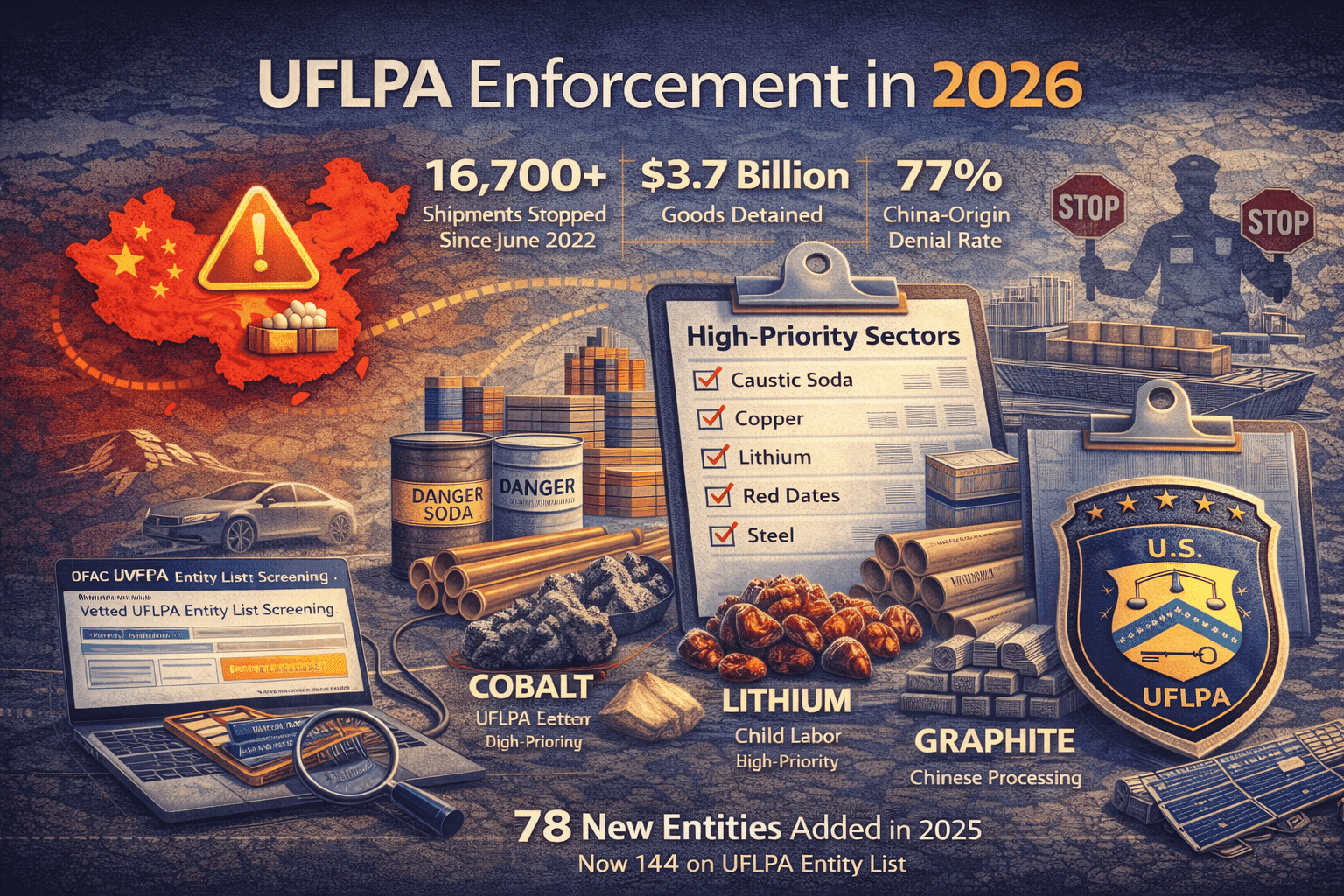
UFLPA enforcement in 2026 has entered a new era—more sectors, more detentions, and higher denial rates than ever before.
If you thought UFLPA enforcement peaked in its early years, think again. The numbers tell a different story.
This guide covers the latest enforcement trends, new priority sectors, and what importers need to prepare for in 2026 and beyond.
UFLPA Enforcement by the Numbers (2025-2026)
The scale of enforcement continues to grow dramatically:
- 16,700+ shipments stopped for examination since June 2022 (DHS, August 2025)
- $3.7 billion in total declared value of detained goods
- 10,000+ shipments valued at nearly $900 million denied entry
- 7,325 shipments stopped in FY2025 alone—a 51% increase over FY2024’s 4,850
- 144 entities now on the UFLPA Entity List, up from 66 in 2024 (USTR)
Denial Rates Are Spiking
For shipments originating directly from China, denial rates jumped to 77% in 2025, up from approximately 60% in 2024 (NQC).
That means if your China-origin shipment gets flagged, there’s now roughly a 3-in-4 chance it won’t enter the US.
New Priority Sectors for 2025-2026
In August 2025, DHS designated five new high-priority sectors for UFLPA enforcement (CM Trade Law):
Newly Added Sectors
- Caustic soda
- Copper
- Lithium
- Red dates (jujubes)
- Steel
Previously Designated Sectors
- Apparel and cotton
- Tomatoes and downstream products
- Polyvinyl chloride (PVC)
- Seafood
- Silica-based products (including polysilicon)
- Aluminum
If you import in any of these sectors, your compliance program needs to be airtight.
Why These New Sectors Matter
The addition of copper, lithium, and steel signals a major shift. These materials are fundamental to automotive, construction, electronics, and energy industries.
Xinjiang has significant production capacity in these sectors, meaning the pool of affected importers just expanded dramatically.
78 New Entities Added in 2025
The 2025 UFLPA Strategy update added 78 new entities to the Entity List—more than doubling its size from 66 to 144 (Kharon).
New additions include companies in:
- Solar and polysilicon manufacturing
- Cotton and textile production
- Mining and metals processing
- Agricultural operations
- Government labor transfer programs
Five solar companies were among the January 2025 additions (Solar Power World).
VettedImport’s screening tools are updated with the latest Entity List additions to catch new matches automatically.
Enforcement Patterns to Watch in 2026
Lower-Value Shipments Under Scrutiny
In 2025, the total value of detained goods per shipment actually declined—but the number of detentions rose. CBP is now targeting lower-value electronics and industrial inputs, not just high-value solar panels and apparel.
This means smaller importers are increasingly in the crosshairs.
Third-Country Enforcement
CBP is getting better at tracing materials through third countries. Goods manufactured in Vietnam, Bangladesh, or Malaysia are being flagged when raw materials trace back to Xinjiang.
Simply moving manufacturing out of China doesn’t eliminate risk if inputs remain Chinese.
Solar Industry Remains Targeted
Despite a brief reduction in solar detentions in mid-2024, enforcement resumed strongly. In 2025, CBP detained solar cells from South Korean-headquartered Hanwha/Qcells (PV Tech), demonstrating that even major non-Chinese manufacturers face scrutiny when polysilicon origins are unclear.
Import Compliance Is Now Board-Level
According to legal analysis, 2026 trade enforcement has made import compliance a board-level risk. This isn’t just a compliance department issue anymore.
What This Means for Your Business
If You Import Apparel or Textiles
Cotton from Xinjiang now accounts for nearly 93% of all Chinese cotton production (up from 90% in 2023). The apparel sector remains the highest-enforcement category.
If You Import Solar or Electronics
Polysilicon tracing continues to intensify. Even panels assembled outside China need verified polysilicon sourcing. The solar industry can’t assume it’s in the clear.
If You Import Metals, Batteries, or Industrial Materials
The new designation of copper, lithium, and steel as priority sectors means these imports will face increasing scrutiny in 2026. If you import automotive parts or EV components, start building your compliance documentation now.
How to Prepare for Increased Enforcement
1. Screen All Suppliers Against Updated Lists
With 144 entities now listed, screening is more important than ever. Screen your suppliers for free with VettedImport.
2. Map Supply Chains for New Priority Materials
If you import copper, lithium, steel, caustic soda, or red dates—map your supply chains now before enforcement ramps up.
3. Collect Documentation Proactively
Don’t wait for detention. Gather origin certificates, supplier declarations, and production records for all high-risk products.
4. Monitor for List Updates
With 78 entities added in a single year, the list is growing fast. Set up monitoring to catch additions that affect your suppliers.
5. Prepare a Detention Response Plan
With 77% denial rates for China-origin shipments, have a plan ready. Know who responds, what documentation to submit, and who your customs attorney is.
FAQs About UFLPA Enforcement in 2026
Is UFLPA enforcement slowing down?
No. While there was a brief monthly slowdown between April and August 2025, the overall trend is significant escalation. FY2025 saw 51% more stopped shipments than FY2024.
Will more sectors be added to the priority list?
Likely yes. DHS has signaled continued expansion. Sectors with significant Xinjiang production—including additional mining, agriculture, and manufacturing categories—could be added in future updates.
Are small importers targeted?
Yes. The shift toward lower-value shipment enforcement means SMBs are increasingly affected. CBP doesn’t differentiate by company size.
How do I know if the Entity List has been updated?
Updates are published in the Federal Register and on the DHS website. Automated screening tools like VettedImport alert you to relevant changes.
What’s the most common reason for denial?
Insufficient documentation to overcome the rebuttable presumption. Importers who can’t trace materials to non-Xinjiang origins consistently face exclusion.
Does UFLPA apply to e-commerce and de minimis shipments?
Yes. There’s growing legislative interest in closing de minimis loopholes. Imports under $800 are increasingly subject to UFLPA scrutiny.
The Bottom Line on 2026 Enforcement
UFLPA enforcement in 2026 is broader, stricter, and more sophisticated than ever.
More sectors. More entities. Higher denial rates. Lower-value targets.
The importers who thrive will be those with proactive screening, documented supply chains, and the ability to respond quickly to CBP requests.
UFLPA enforcement in 2026 isn’t slowing down—it’s accelerating across industries, and every importer needs a compliance strategy.