

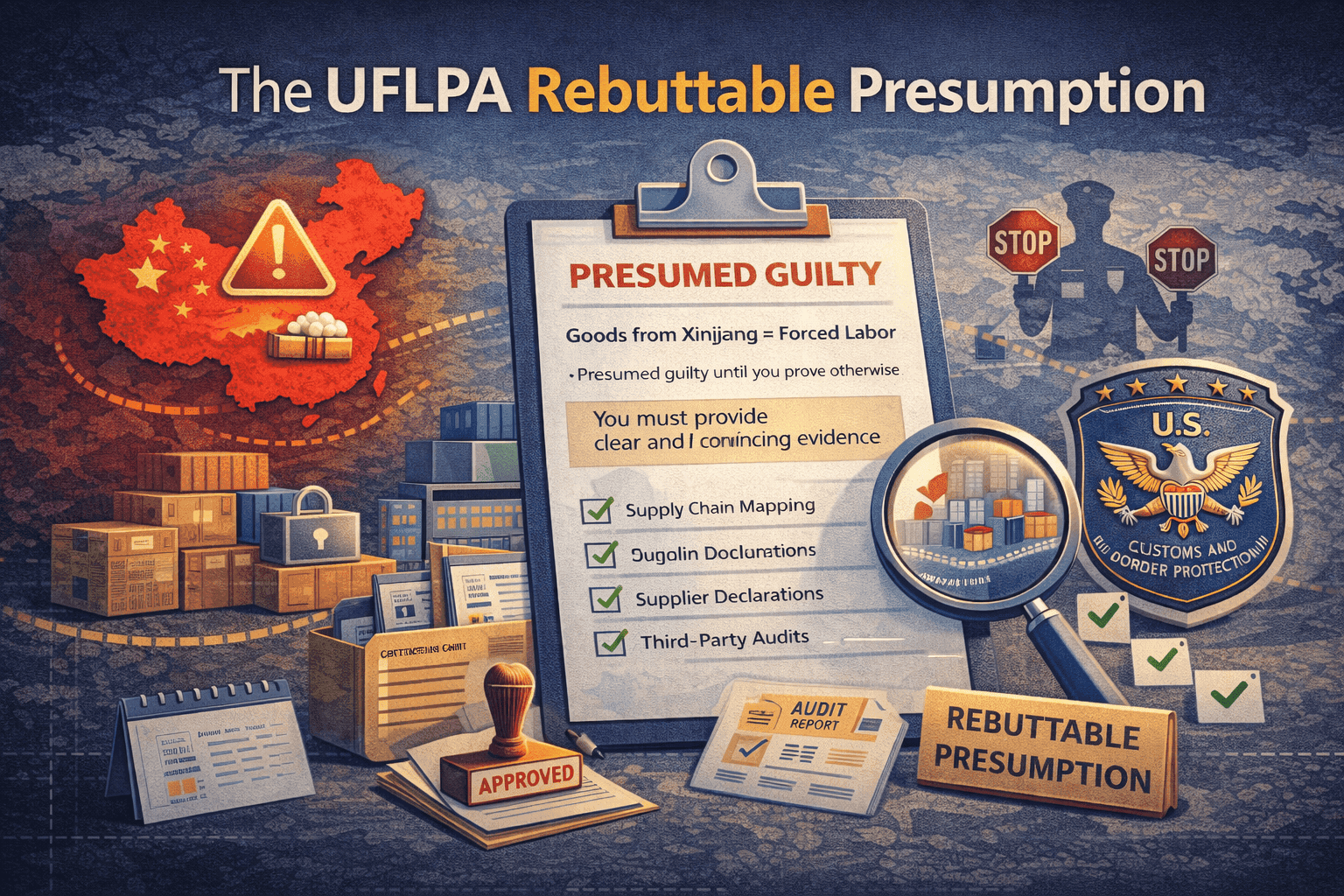
The UFLPA rebuttable presumption is the legal mechanism that makes this law so powerful—and so challenging for importers.
Understanding how it works is essential for anyone importing goods with potential connections to China’s Xinjiang region.
This guide breaks down what the presumption means, how to overcome it, and why proactive compliance is your best strategy.
What is a Rebuttable Presumption?
A rebuttable presumption is a legal term meaning something is assumed to be true unless you prove otherwise.
Under UFLPA, the presumption is:
“All goods mined, produced, or manufactured wholly or in part in the Xinjiang Uyghur Autonomous Region of China are made with forced labor.”
This means:
- CBP doesn’t need to prove forced labor was used
- Your goods are presumed guilty
- You must provide evidence to rebut (disprove) the presumption
- The standard of evidence is “clear and convincing”—a high bar
How This Differs From Previous Enforcement
Before UFLPA: CBP Had the Burden
Under Section 307 of the Tariff Act and Withhold Release Orders (WROs):
- CBP had to develop evidence of forced labor
- Targeted specific companies with specific orders
- Limited in scope and enforcement capacity
After UFLPA: Importers Have the Burden
- Any Xinjiang connection triggers the presumption
- Importers must prove compliance, not CBP
- Applies broadly to all goods, not just specific orders
- Much easier for CBP to enforce at scale
This shift is why UFLPA has been so effective—and why detention numbers have surged.
What Triggers the Presumption?
The presumption applies when CBP believes goods have any of these connections:
1. Xinjiang Origin
Goods mined, produced, or manufactured in Xinjiang—even partially. If one component or raw material comes from the region, the entire product is subject.
2. Entity List Connection
Goods produced by or connected to companies on the UFLPA Entity List, regardless of where manufacturing occurs.
3. Government Labor Programs
Goods produced using workers recruited through Xinjiang government labor transfer programs.
The “Clear and Convincing” Standard
To overcome the presumption, you need “clear and convincing evidence.” This is higher than the typical “preponderance of evidence” standard.
What It Means in Practice
- Not enough: Supplier says “we don’t use forced labor”
- Not enough: Generic certificates without specific details
- Not enough: Partial supply chain documentation
- Better: Complete supply chain map with documentation at every tier
- Better: Third-party audits confirming labor practices
- Best: Comprehensive evidence package with verified origin, audits, declarations, and production records
What CBP Wants to See
- Supply chain map – Every entity from raw material to finished product
- Origin evidence – Certificates proving where materials actually come from
- Production records – Purchase orders, invoices, batch records linking specific goods to documented origins
- Supplier declarations – Written statements specifically addressing Xinjiang and forced labor
- Third-party verification – Independent audits carry significant weight
- Due diligence records – Evidence of your screening and compliance program
Can You Actually Overcome the Presumption?
Yes, but success depends on your situation:
Easier to Overcome
- Goods manufactured entirely outside China
- Raw materials from verified non-Xinjiang sources
- Complete, documented supply chain
- Third-party audits confirming origin and labor practices
Difficult to Overcome
- Goods with actual Xinjiang connections (even partial)
- Incomplete supply chain documentation
- Commodity products with mixed origins
- Suppliers unwilling to provide transparency
Practically Impossible to Overcome
- Direct UFLPA Entity List connections
- Goods manufactured in Xinjiang
- No supply chain documentation available
How to Prepare for the Presumption
Before You Order
- Screen suppliers against Entity List and OFAC using VettedImport’s screening tools
- Ask specific questions about material origins
- Require supply chain transparency in contracts
- Choose suppliers who can document their full supply chain
Before You Ship
- Collect documentation at every supply chain tier
- Verify consistency across all documents
- Organize evidence for quick CBP response
If You’re Detained
- Respond within deadlines (request extensions if needed)
- Submit comprehensive evidence not partial packages
- Be honest about what you know and don’t know
- Consider legal counsel for high-value shipments
FAQs About the UFLPA Rebuttable Presumption
Does the presumption apply to goods from all of China?
No, only goods connected to Xinjiang or Entity List entities. Goods from other Chinese provinces aren’t automatically subject—but CBP may still ask questions.
What if I prove my goods are clean once? Do I need to prove it again?
Yes. Each shipment is evaluated independently. Successfully clearing one detention doesn’t prevent future ones, even for identical products from the same supplier.
Is the presumption permanent?
UFLPA has no sunset clause. The presumption remains until Congress changes the law, which is unlikely given bipartisan support.
Can I appeal a CBP decision?
Yes. If goods are excluded, you can protest the decision through administrative channels. Consult a customs attorney for the appeals process.
Does the presumption apply to goods in transit?
Yes. The presumption applies at the point of importation, regardless of when goods were manufactured or shipped.
What happens if I can’t overcome the presumption?
Goods are excluded from entry. You can typically export them to another country or abandon them to CBP. In some cases, goods may be seized.
The Bottom Line on the Rebuttable Presumption
The rebuttable presumption is what makes UFLPA fundamentally different from previous forced labor enforcement.
It shifts the burden to importers, makes enforcement scalable for CBP, and creates a strong incentive for proactive compliance.
The smartest approach: build your documentation before you need it, not after CBP asks for it.
The UFLPA rebuttable presumption means your goods are presumed guilty—building the evidence to prove innocence starts with screening your suppliers today.