

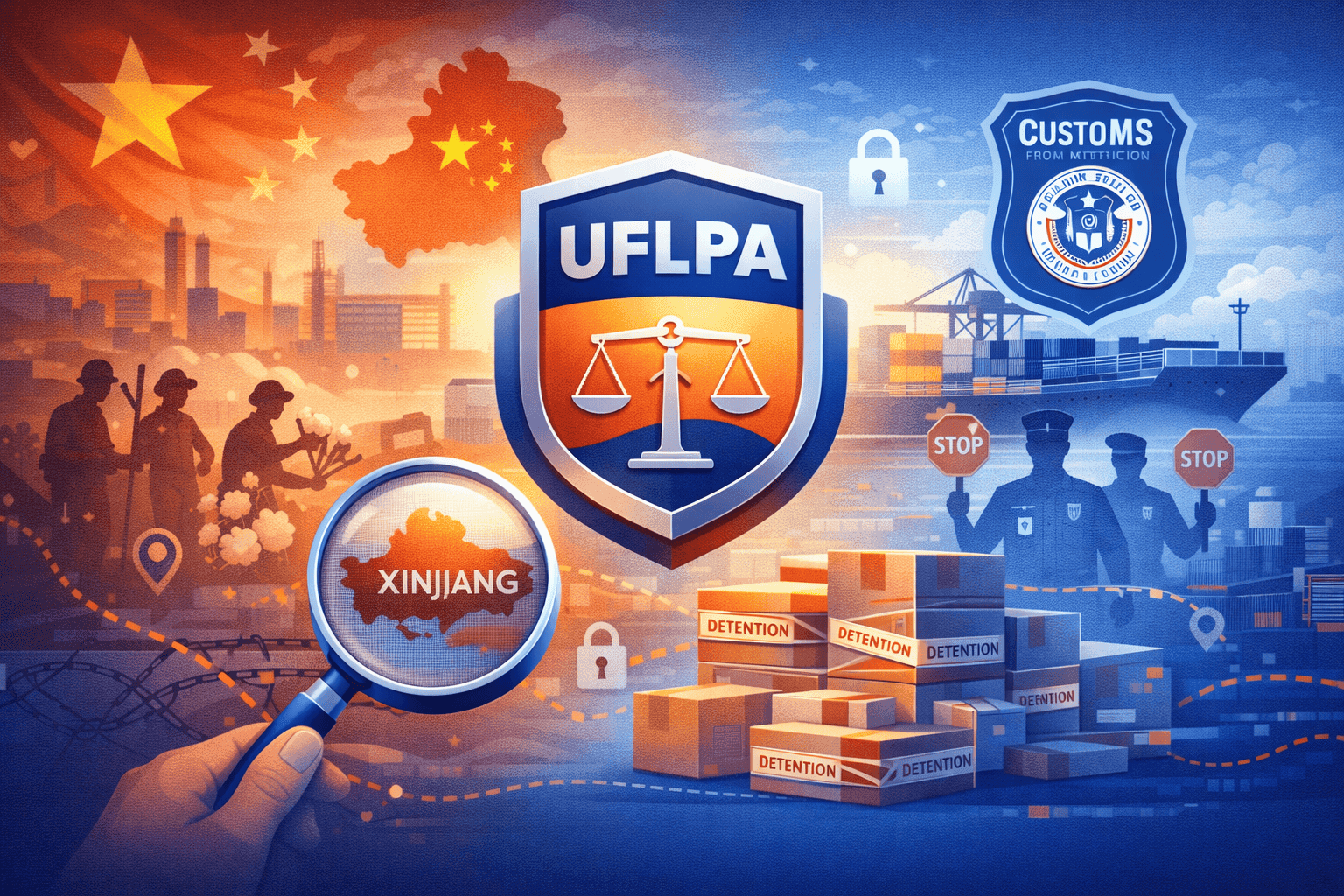
The Uyghur Forced Labor Prevention Act (UFLPA) represents one of the most significant changes to US import regulations in decades. If you import goods from China, understanding this law is essential to protecting your business from costly detentions and shipment seizures.
What is the UFLPA?
The UFLPA is a US federal law that went into effect on June 21, 2022. It establishes a rebuttable presumption that any goods mined, produced, or manufactured wholly or in part in the Xinjiang Uyghur Autonomous Region (XUAR) of China are made with forced labor.
Under US law, goods made with forced labor cannot be imported into the United States. The UFLPA makes CBP’s job easier by assuming—unless you prove otherwise—that anything connected to Xinjiang is prohibited.
The Rebuttable Presumption Explained
This is the key concept importers must understand. Unlike other customs violations where CBP must prove wrongdoing, UFLPA flips the burden of proof onto you, the importer.
When CBP suspects your goods have a connection to Xinjiang, they will detain your shipment. To release your goods, you must prove with clear and convincing evidence that:
- The goods were not made wholly or in part in Xinjiang
- No forced labor was used in any part of the supply chain
This is a high bar to clear, especially if you haven’t documented your supply chain before detention.
Who is Affected by UFLPA?
While the law technically applies to all goods with Xinjiang connections, CBP has prioritized enforcement in several high-risk sectors:
High-Priority Sectors
- Apparel and Textiles: Cotton from Xinjiang accounts for 85% of Chinese cotton production
- Solar Panels: 45% of global polysilicon comes from Xinjiang
- Silica-Based Products: Including electronics components
- Tomato and Agricultural Products: Xinjiang is a major tomato producer
The Entity List
The DHS maintains a UFLPA Entity List of companies that:
- Mine, produce, or manufacture goods in Xinjiang
- Work with the Xinjiang government on labor transfer programs
- Are affiliated with entities on the list
If any of your suppliers are on this list, your goods will face immediate scrutiny.
CBP Enforcement Statistics
Since enforcement began in June 2022, CBP has:
- Reviewed over 8,000 shipments under UFLPA
- Detained goods worth over $3 billion
- Maintained approximately 60% of detentions in the apparel/textiles sector
- Denied entry to hundreds of shipments where importers couldn’t prove compliance
These numbers continue to grow as CBP expands its enforcement capabilities.
What Happens When Goods Are Detained?
When CBP detains your goods under UFLPA:
- You receive a detention notice with 5 days to respond
- You have 30 days to provide evidence rebutting the presumption
- CBP reviews your evidence and makes a determination
- If insufficient, goods can be seized, exported, or destroyed
During detention, you may face:
- Storage fees at the port
- Delayed deliveries to customers
- Potential contract penalties
- Damage to business relationships
How to Protect Your Business
Proactive compliance is far easier than reactive documentation. Here’s what smart importers are doing:
1. Know Your Supply Chain
Map your supply chain beyond your direct suppliers. Where do they source materials? Who are their suppliers? The more visibility you have, the better.
2. Screen Against the Entity List
Before placing orders, verify that your suppliers (and their suppliers) are not on the UFLPA Entity List. This single step can prevent many detentions.
3. Collect Documentation Early
Don’t wait for a detention to gather documentation. Collect origin certificates, supplier declarations, and audit reports now.
4. Maintain Traceability Records
Keep records that trace materials from origin to finished product. This chain of custody documentation is critical for CBP requests.
5. Use Technology
Manual supply chain tracking is error-prone and time-consuming. Tools like VettedImport automate supplier screening and help organize compliance documentation.
The Bottom Line
UFLPA compliance isn’t optional—it’s a requirement for doing business with Chinese supply chains. The importers who thrive will be those who proactively screen their suppliers, document their supply chains, and stay ahead of CBP enforcement.
The cost of non-compliance (detained goods, lost shipments, damaged relationships) far exceeds the cost of building a robust compliance program.
Ready to get UFLPA compliant? VettedImport helps importers screen suppliers against the Entity List and build CBP-ready documentation. Get started free.