

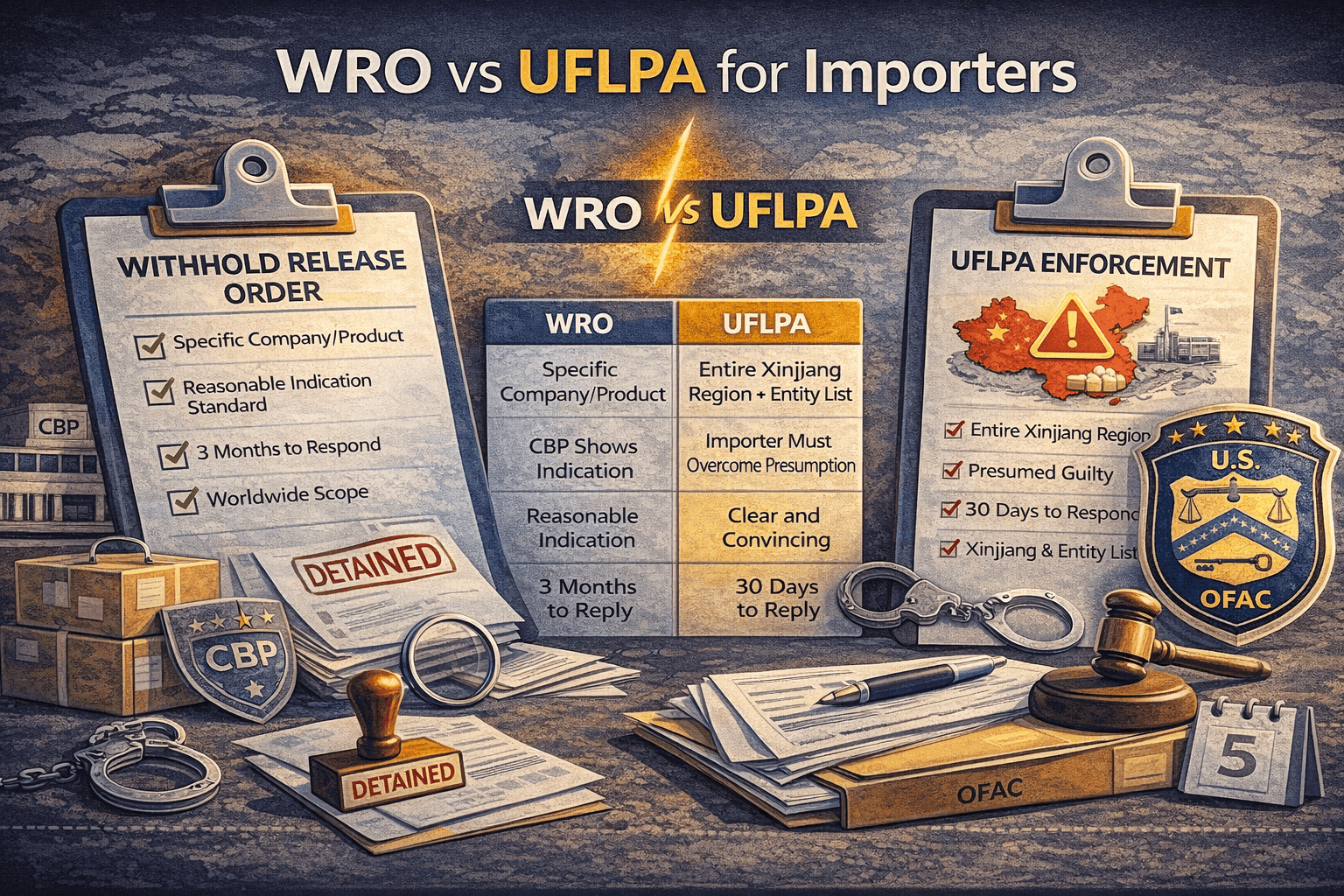
Understanding the difference between a WRO vs UFLPA is critical if you import goods that may have forced labor connections.
Both are tools CBP uses to stop forced-labor goods at the border, but they work very differently—and the consequences for importers aren’t the same.
This guide explains how each works, which one applies to your situation, and what you need to do about it.
What is a Withhold Release Order (WRO)?
A WRO is an enforcement tool under Section 307 of the Tariff Act of 1930, which prohibits importing goods made with forced labor.
CBP can issue a WRO when information “reasonably but not conclusively” indicates forced labor was used (CBP).
How WROs Work
- CBP receives information suggesting forced labor in a specific supply chain
- CBP investigates and issues a WRO targeting a specific company or region
- Goods from the targeted entity are detained at port
- Importer has 3 months to provide evidence that goods are not made with forced labor
- CBP decides: release, exclude, or issue a formal “Finding”
Current Active WROs
CBP maintains active WROs against entities worldwide, including companies in China, Malaysia, and other countries. The CBP WRO Dashboard tracks all active orders.
What is the UFLPA?
The Uyghur Forced Labor Prevention Act is a 2021 federal law that created a rebuttable presumption that goods from Xinjiang are made with forced labor.
How UFLPA Works
- Any goods with Xinjiang or Entity List connections are presumed to involve forced labor
- CBP detains goods based on this presumption
- Importer has 30 days to provide “clear and convincing evidence” to rebut
- CBP decides: release, exclude, or seize
Key Differences: WRO vs UFLPA
| Feature | WRO | UFLPA |
|---|---|---|
| Legal basis | Section 307, Tariff Act of 1930 | Uyghur Forced Labor Prevention Act (2021) |
| Scope | Specific companies or products | Entire Xinjiang region + Entity List |
| Burden of proof | CBP must show “reasonable indication” | Importer must overcome presumption |
| Evidence standard | Lower—admissibility evidence | Higher—”clear and convincing” |
| Response time | 3 months | 30 days |
| Geographic focus | Any country | China (Xinjiang specifically) |
| Trigger | CBP investigation into specific entity | Any Xinjiang/Entity List connection |
| Enforcement approach | Reactive (CBP investigates first) | Proactive (presumption-based) |
Source: Barnes, Richardson & Colburn
Which One Applies to You?
UFLPA Applies If:
- Your goods have any connection to Xinjiang
- Your supplier is on the UFLPA Entity List (144 entities as of 2025)
- Raw materials in your supply chain originate from Xinjiang
- Your goods were previously subject to Xinjiang-related WROs
WRO Applies If:
- CBP has issued a specific WRO against your supplier or product category
- Forced labor allegations involve non-Xinjiang entities
- Your goods are from countries other than China (Malaysia, Thailand, etc.) with forced labor issues
Both Can Apply
Some goods may be subject to both. However, since UFLPA took effect, shipments previously subject to Xinjiang-related WROs are now processed under UFLPA procedures (White & Case).
Why the UFLPA Is Harder for Importers
1. Reversed Burden of Proof
Under WROs, CBP needs evidence of forced labor to detain. Under UFLPA, your goods are presumed guilty—you must prove they’re clean.
2. Higher Evidence Standard
“Clear and convincing evidence” under UFLPA is a significantly higher bar than what’s required under WROs.
3. Shorter Response Time
30 days under UFLPA vs. 3 months under WROs. That’s less time to gather evidence from suppliers who may be overseas in different time zones.
4. Broader Scope
WROs target specific entities. UFLPA covers an entire region (Xinjiang) and everyone on a growing Entity List.
CBP’s First Guide to Modifying WROs (2025)
In June 2025, CBP issued its first comprehensive guide for modifying WROs (CM Trade Law). This guide outlines how companies can demonstrate changed practices to have a WRO modified or revoked.
No equivalent process exists yet for UFLPA Entity List removal, making UFLPA listings effectively permanent.
How to Protect Against Both WROs and UFLPA
The good news: the same compliance practices protect against both enforcement tools.
1. Screen Suppliers
Check against UFLPA Entity List, OFAC SDN, and active WRO targets. VettedImport screens against all major lists.
2. Map Supply Chains
Know where materials originate. This protects against both Xinjiang-specific UFLPA risk and broader forced labor WROs.
3. Collect Documentation
Origin certificates, supplier declarations, production records—essential for responding to either type of enforcement.
4. Monitor for Updates
Both the Entity List and WRO list change regularly. Stay current.
FAQs About WRO vs UFLPA
Can I be subject to both a WRO and UFLPA on the same shipment?
For Xinjiang-related goods, UFLPA takes precedence. For forced labor issues outside Xinjiang, WROs still apply independently.
Is it easier to overcome a WRO or UFLPA presumption?
WROs are generally easier to overcome—lower evidence standard and longer response time. UFLPA’s “clear and convincing” standard with 30-day deadline is significantly more challenging.
Do WROs still exist for Xinjiang goods?
Existing Xinjiang-related WROs remain in effect, but enforcement has shifted to UFLPA procedures. New Xinjiang-related enforcement uses UFLPA, not WROs.
Are WROs only for Chinese goods?
No. CBP issues WROs against entities worldwide. Active WROs target goods from Malaysia, Brazil, and other countries in addition to China.
What happens if a WRO is modified or revoked?
If CBP modifies or revokes a WRO, goods from that entity can enter the US. However, if the entity is also on the UFLPA Entity List, UFLPA enforcement still applies.
The Bottom Line
WROs and UFLPA both stop forced-labor goods at the border, but UFLPA is far more powerful for Xinjiang-related enforcement.
For most importers sourcing from China, UFLPA is the primary concern. But WROs remain relevant for non-Xinjiang forced labor issues and for importers sourcing from other high-risk countries.
A comprehensive compliance program—screening, documentation, supply chain mapping—protects against both.
Whether you’re facing a WRO or UFLPA enforcement, the solution is the same: know your supply chain and prove it.