

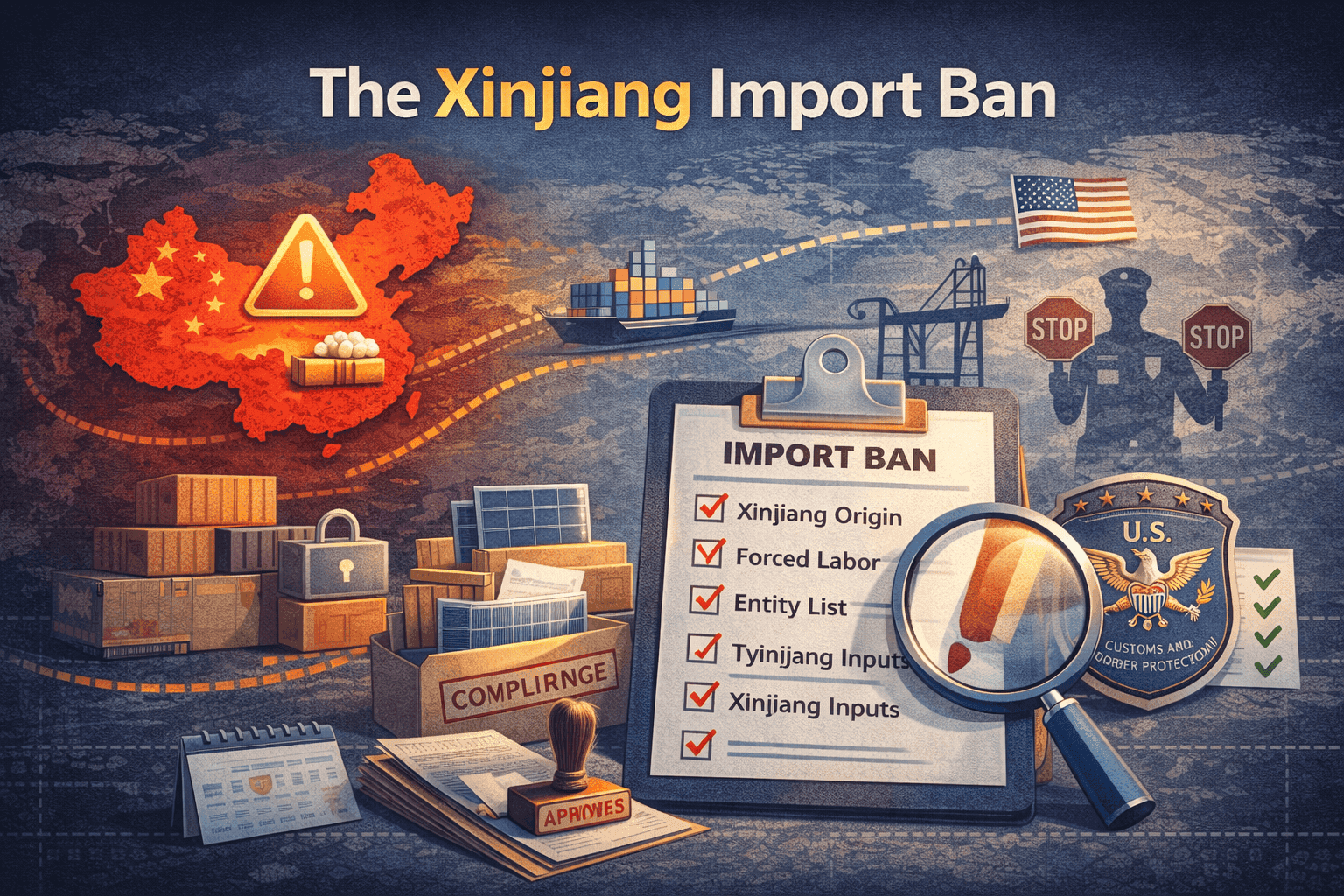
The Xinjiang import ban has fundamentally changed how goods flow from China to the United States.
If you source products from China—or from countries that process Chinese materials—you need to understand this ban and how it affects your business.
This guide explains what the ban covers, how CBP enforces it, and what you need to do to keep importing safely.
What is the Xinjiang Import Ban?
The “Xinjiang import ban” refers to the enforcement of the Uyghur Forced Labor Prevention Act (UFLPA), signed into law in December 2021 and enforced since June 21, 2022.
The law creates a rebuttable presumption that all goods mined, produced, or manufactured wholly or in part in the Xinjiang Uyghur Autonomous Region (XUAR) of China are made with forced labor.
Under existing US law (Section 307 of the Tariff Act), goods made with forced labor cannot be imported into the United States.
Effectively: goods from Xinjiang are banned unless you prove otherwise.
What Does the Ban Cover?
Directly: Goods From Xinjiang
Any product mined, produced, or manufactured in Xinjiang is presumed to be made with forced labor. This includes:
- Cotton and cotton products
- Polysilicon and solar panels
- Tomatoes and tomato products
- Electronics components
- Human hair products
- Any other goods from the region
Indirectly: Goods With Xinjiang Inputs
This is where it gets broader. The ban also covers goods manufactured anywhere in the world if they contain inputs from Xinjiang.
Examples:
- A shirt made in Vietnam using cotton grown in Xinjiang
- Solar panels assembled in Malaysia using polysilicon from Xinjiang
- Tomato sauce made in Italy using Xinjiang tomato paste
- Electronics built in South Korea using Xinjiang silicon
The ban follows the materials, not just the final manufacturing location.
Entity List Connections
Goods produced by companies on the UFLPA Entity List are also presumed to be made with forced labor, regardless of where manufacturing occurs.
What Products Are Most Affected?
Cotton and Textiles (60%+ of detentions)
Xinjiang produces approximately 85% of China’s cotton and 20% of global supply. The apparel industry faces the highest enforcement volume.
Solar Panels and Polysilicon
Approximately 45% of global polysilicon comes from Xinjiang. The solar industry has seen significant detentions.
Tomatoes and Agriculture
Xinjiang is a major tomato-producing region. The agriculture sector faces growing scrutiny.
Automotive Components
EV batteries and automotive parts are increasingly targeted as supply chain tracing improves.
Electronics and Silica Products
Silicon-based components used in electronics have Xinjiang exposure through polysilicon production.
How CBP Enforces the Ban
Targeting and Detection
CBP uses multiple methods to identify shipments with potential Xinjiang connections:
- Import data analysis – Matching shipments against Entity List company names
- Country of origin reviews – Flagging goods from China in high-risk categories
- Intelligence sharing – Tips from other agencies, NGOs, and competitors
- Supply chain investigations – Tracing materials through production networks
The Detention Process
- CBP identifies a shipment with potential Xinjiang connections
- Goods are detained at the port of entry
- Importer receives notice with 5 business days to respond
- 30-day window to provide “clear and convincing evidence” rebutting the presumption
- CBP decides: release, exclude, or seize
Enforcement Statistics
Since June 2022, CBP has:
- Reviewed 8,000+ shipments
- Detained goods worth over $3 billion
- Maintained 60%+ detention rate in apparel/textiles
- Expanded enforcement across industries
Can You Still Import From China?
Yes—but with precautions.
The ban targets Xinjiang specifically, not all Chinese goods. You can still import from China if:
- Your goods and raw materials don’t originate from Xinjiang
- Your suppliers aren’t on the Entity List
- You can document the origin of materials
- You have a compliance program in place
What You Need to Prove
If CBP questions your shipment, you must demonstrate:
- Goods were NOT made in Xinjiang
- No raw materials originated from Xinjiang
- No Entity List companies are in your supply chain
- No forced labor was used at any stage
The burden of proof is on you, the importer.
How to Comply With the Xinjiang Import Ban
1. Screen Your Suppliers
Check all suppliers against:
- UFLPA Entity List
- OFAC SDN List
- Known Xinjiang-connected entities
VettedImport provides instant screening against all major watch lists.
2. Map Your Supply Chain
Document the full journey from raw materials to finished goods:
- Where are raw materials sourced?
- Where does processing occur?
- Who are your suppliers’ suppliers?
- Can you trace materials to their origin?
3. Collect Origin Documentation
- Certificates of Origin (specific to province level)
- Supplier declarations about Xinjiang and forced labor
- Production records linking your goods to claimed origins
- Third-party audit reports
4. Diversify High-Risk Supply Chains
For high-risk materials like cotton and polysilicon, consider sourcing from non-China origins:
- Cotton: United States, Brazil, India, Australia
- Polysilicon: South Korea, Germany, United States
- Tomatoes: United States, Italy, Spain
5. Build a Compliance Program
Systematic compliance is more effective than ad-hoc responses:
- Screening policies for new suppliers
- Documentation requirements in contracts
- Ongoing monitoring for list updates
- Response plan for detentions
Learn more about the UFLPA compliance challenge.
Exceptions and the Rebuttable Presumption
Can You Overcome the Presumption?
Yes, but the bar is high. You need “clear and convincing evidence” that:
- Your goods are not made with forced labor, AND
- You’ve complied with CBP’s due diligence requirements
What CBP Considers “Clear and Convincing”
- Complete supply chain mapping
- Verifiable origin documentation at every tier
- Third-party audits or certifications
- Consistent, comprehensive evidence package
In practice, very few importers have successfully overcome the presumption for goods with actual Xinjiang connections. Prevention is far easier than remediation.
FAQs About the Xinjiang Import Ban
Does the ban apply to all goods from China?
No, only goods with connections to Xinjiang or the UFLPA Entity List. You can still import from other Chinese provinces with proper documentation.
What if my goods are made in a third country but use Chinese materials?
If those materials originated in Xinjiang, the ban still applies. CBP traces materials to their origin, not just the final manufacturing location.
How long will the ban last?
UFLPA has no sunset clause. It will remain in effect indefinitely. If anything, enforcement is expanding, not contracting.
What about goods already in transit?
The ban applies at the time of import, not at the time of purchase or shipment. Goods already in transit can be detained upon arrival.
Can I re-export detained goods?
In many cases, yes. If goods are excluded (denied entry), you typically have the option to export them to another country at your expense.
Are there any exemptions for small businesses?
No. UFLPA applies equally to all importers regardless of size. CBP enforces the same standards for SMBs as it does for large corporations.
What about goods purchased through marketplaces like Alibaba?
Same rules apply. As the importer of record, you’re responsible for UFLPA compliance regardless of how you sourced the goods.
The Bottom Line on the Xinjiang Import Ban
The Xinjiang import ban is here to stay—and enforcement continues to intensify.
For importers, the path forward is clear: know your supply chain, screen your suppliers, document everything, and build compliance into your sourcing process.
Importers who adapt will continue to thrive. Those who ignore the ban will face increasingly costly consequences.
The Xinjiang import ban affects every importer sourcing from China—understanding it isn’t optional, it’s essential.