

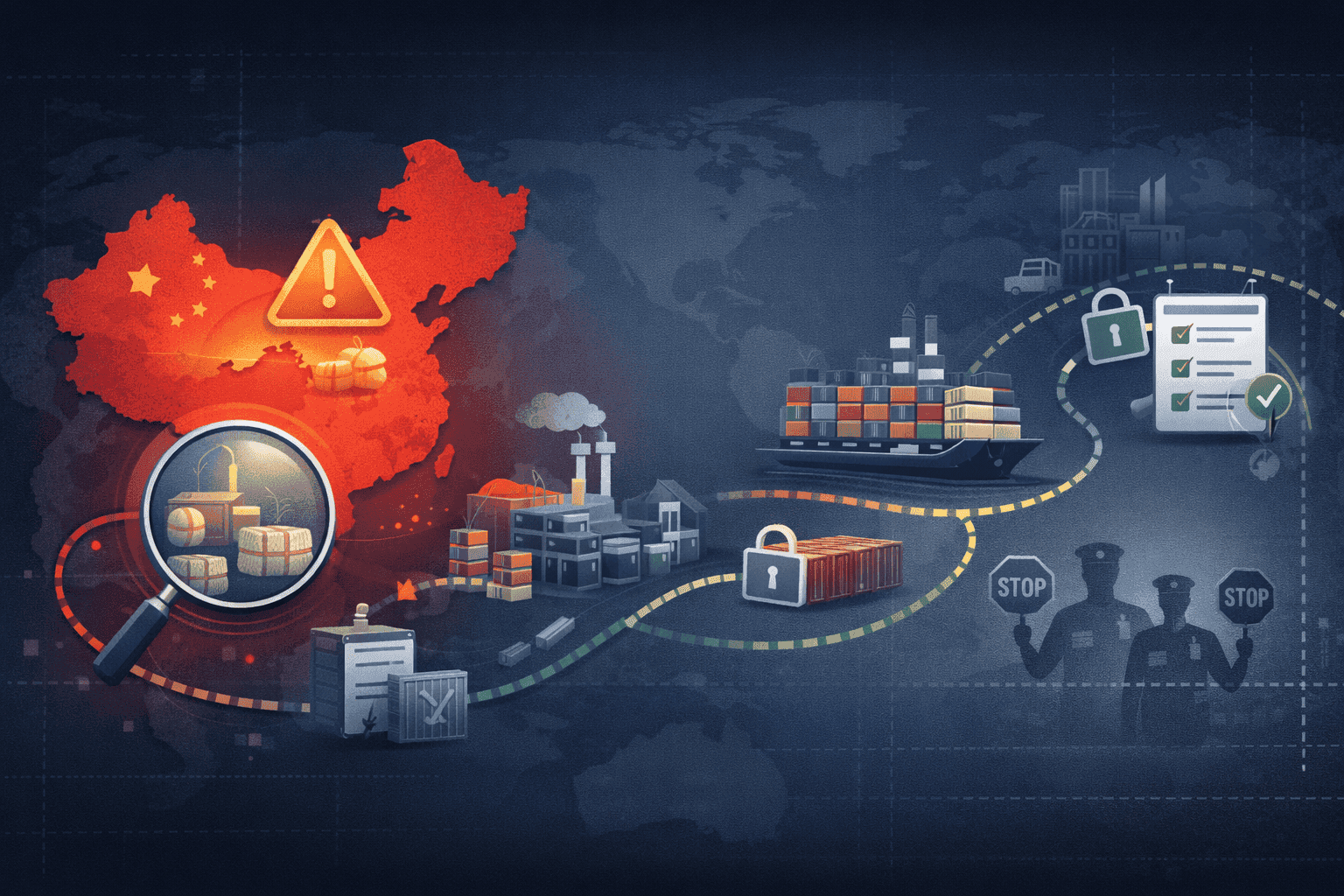
XPCC sanctions have transformed how US importers approach supply chains connected to China’s Xinjiang region.
If you import cotton, textiles, tomatoes, or agricultural products, you need to understand XPCC—and why connections to this entity can stop your goods at the border.
This guide explains what XPCC is, why it’s sanctioned, and how to ensure your supply chain stays clean.
What is XPCC?
XPCC stands for the Xinjiang Production and Construction Corps.
It’s a unique quasi-governmental organization in China—part economic enterprise, part paramilitary force. XPCC operates farms, factories, and entire cities across Xinjiang.
Think of it as a state-within-a-state controlling massive portions of Xinjiang’s economy.
XPCC by the Numbers
- 3 million+ members (employees and families)
- 33% of Xinjiang’s cotton production
- Thousands of subsidiaries across agriculture, textiles, construction, and manufacturing
- $40+ billion in annual revenue
XPCC is embedded throughout Xinjiang’s economy, making it nearly impossible to source certain goods from the region without some connection to the organization.
Why is XPCC Sanctioned?
XPCC faces sanctions from multiple US government agencies for its role in human rights abuses against Uyghurs and other ethnic minorities.
UFLPA Entity List
XPCC was among the first entities added to the UFLPA Entity List when enforcement began in June 2022.
The designation means any goods connected to XPCC face the rebuttable presumption of forced labor.
OFAC Sanctions
The Treasury Department’s Office of Foreign Assets Control (OFAC) sanctioned XPCC in July 2020 under the Global Magnitsky Act.
This makes XPCC a Specially Designated National (SDN)—US persons cannot conduct business with XPCC without risking severe penalties.
Export Controls
The Commerce Department’s Bureau of Industry and Security (BIS) has added XPCC subsidiaries to the Entity List (separate from UFLPA), restricting exports of US technology.
How XPCC Connections Affect Importers
Here’s the challenge: XPCC’s reach extends far beyond its direct operations.
Direct XPCC Products
Products made directly by XPCC subsidiaries:
- Cotton and cotton yarn
- Tomato paste and tomato products
- Agricultural commodities
- Textiles and garments
These are automatically flagged at US ports.
Indirect XPCC Connections
The bigger risk for most importers:
- Cotton from XPCC farms processed by non-XPCC mills
- Yarn spun from XPCC cotton used in third-country garments
- Tomatoes from XPCC farms processed into paste sold globally
- Materials from XPCC suppliers used in finished goods
Your direct supplier might be in Vietnam or Bangladesh, but if their raw materials trace back to XPCC, your goods are at risk.
Industries Most Affected by XPCC Sanctions
Apparel and Textiles
The apparel industry faces the highest risk. XPCC controls roughly one-third of Xinjiang’s cotton production, and Xinjiang produces 85% of China’s cotton.
Cotton flows through complex global supply chains:
XPCC Farm → Chinese Ginner → Spinner (China/Vietnam/Bangladesh) → Fabric Mill → Garment Factory → US Importer
By the time cotton becomes a finished shirt, proving it didn’t originate from XPCC requires documentation at every step.
Food and Agriculture
The agriculture sector is increasingly scrutinized. XPCC is a major producer of:
- Tomatoes and tomato paste
- Peppers and dried vegetables
- Fruits and fruit concentrates
- Seeds and agricultural inputs
Food importers must trace ingredients back to farm level to ensure no XPCC connection.
Identifying XPCC Connections in Your Supply Chain
XPCC operates through hundreds of subsidiaries with names that don’t obviously connect to the parent organization.
Common XPCC Subsidiary Naming Patterns
- Names containing “兵团” (Bingtuan – Corps)
- Names with division numbers (e.g., “First Division,” “Eighth Division”)
- Regional names + “Agricultural” or “Construction”
- Companies registered in Xinjiang cities like Shihezi, Aral, or Tumxuk
Red Flags to Watch For
- Suppliers located in XPCC-controlled cities
- Unusually low prices for Xinjiang-region goods
- Suppliers unwilling to disclose sub-suppliers
- Certificates of origin from Xinjiang without detailed sourcing
How to Screen for XPCC Connections
Effective screening requires checking multiple levels of your supply chain.
Step 1: Screen Direct Suppliers
Check your tier-1 suppliers against:
- UFLPA Entity List (DHS)
- OFAC SDN List (Treasury)
- BIS Entity List (Commerce)
VettedImport screens against all these lists simultaneously, catching connections that manual searches miss.
Step 2: Map Upstream Suppliers
Ask your direct suppliers:
- Where do you source raw materials?
- Who are your cotton/ingredient suppliers?
- Can you provide documentation of material origins?
Step 3: Require Written Declarations
Get suppliers to sign declarations specifically stating:
- No materials sourced from XPCC or XPCC subsidiaries
- No materials from Xinjiang without verified non-XPCC origin
- Willingness to provide supply chain documentation
Step 4: Verify with Documentation
Collect and maintain:
- Certificates of origin for raw materials
- Supplier attestations at each tier
- Third-party audit reports where available
- Transaction records showing material flow
What Happens If CBP Finds XPCC Connections
If CBP identifies potential XPCC connections in your shipment:
- Detention – Your goods are held at the port
- Notice – You receive formal notification with 5 days to respond
- Evidence request – CBP asks for documentation proving non-XPCC origin
- 30-day deadline – You must provide “clear and convincing evidence”
- Decision – Release, exclusion, or seizure
Without proper documentation, your goods won’t enter the US.
Learn more about the UFLPA compliance challenge and how to prepare.
Case Example: Cotton Apparel Detention
A mid-size apparel importer ordered 10,000 units of cotton t-shirts from a Vietnamese manufacturer.
The problem: The Vietnamese factory sourced yarn from a Chinese spinner who bought cotton from an XPCC-affiliated ginner in Xinjiang.
The result:
- Shipment detained at Los Angeles port
- $45,000 in storage fees over 60 days
- Unable to provide adequate origin documentation
- Goods ultimately excluded from entry
- Total loss: $180,000+ (goods + fees + lost sales)
The lesson: Screening your direct supplier isn’t enough. You need visibility into the entire supply chain.
Building an XPCC-Free Supply Chain
Short-Term Actions
- Screen all current suppliers against sanctions lists
- Request supplier declarations confirming no XPCC connections
- Document existing supply chains as thoroughly as possible
Medium-Term Actions
- Diversify sourcing away from China for high-risk materials
- Require supply chain transparency in supplier contracts
- Implement ongoing monitoring for sanctions list updates
Long-Term Actions
- Build relationships with verified non-Xinjiang suppliers
- Invest in traceability systems for critical materials
- Consider third-party audits for high-risk supply chains
FAQs About XPCC Sanctions
Are all Xinjiang products connected to XPCC?
No, but XPCC controls significant portions of key industries. Products from Xinjiang require careful verification to confirm they’re not XPCC-connected.
Can I import from XPCC subsidiaries if the goods aren’t made with forced labor?
No. XPCC is sanctioned by OFAC, meaning US persons cannot transact with XPCC regardless of labor practices. Additionally, UFLPA presumes forced labor for any XPCC-connected goods.
How do I know if a Chinese company is an XPCC subsidiary?
Check the UFLPA Entity List, OFAC SDN List, and BIS Entity List. Also research company registration details—XPCC subsidiaries are often registered in Xinjiang with connections to numbered “divisions.”
What if my supplier says they don’t use XPCC materials but can’t prove it?
Verbal assurances aren’t enough. Require written declarations and supporting documentation. If a supplier can’t document their supply chain, consider that a red flag.
Does screening once protect me forever?
No. Sanctions lists update regularly. A supplier clean today might be listed tomorrow, or might start sourcing from newly-listed entities. Continuous monitoring is essential.
What’s the penalty for importing XPCC-connected goods?
Under UFLPA, goods are detained and potentially seized. Under OFAC, penalties can reach millions of dollars plus criminal liability for willful violations.
The Bottom Line on XPCC Sanctions
XPCC sanctions aren’t going away. If anything, enforcement continues to intensify as CBP builds capacity and adds entities to watch lists.
For importers in textiles, agriculture, and related industries, XPCC-free supply chains are now a business requirement—not a nice-to-have.
The importers who invest in screening, documentation, and supply chain visibility will thrive.
Those who ignore XPCC risk will face detentions, losses, and potentially business-ending penalties.
Understanding XPCC sanctions is essential for any importer sourcing cotton, textiles, or agricultural products from China or countries that process Chinese materials.